The House Always Optimizes: Gambling Is the Most Search-Optimized Industry on the Web
Most of the web is bad at SEO. Across 3.4 million classified URLs, just 1.9% of sites pass a baseline technical SEO check — clean titles and meta descriptions, crawlable structure, valid canonicals, the fundamentals. The median website is an SEO write-off. The conventional explanation is that SEO is hard, undervalued, and easy to neglect, so almost everyone neglects it.
Almost everyone. One industry treats search visibility as an existential requirement rather than a marketing nicety, and the data shows it. When we ranked all 58 content categories by the share of sites passing technical SEO, the leaderboard was unremarkable — Finance, Health, Law clustered around 3-4% — except for a single bar that ran clean off the chart.
We cross-referenced 78,490 gambling sites in LLMSE's index against six quality dimensions — SEO, AEO (optimization for AI answer engines), EEAT (trust signals), WCAG accessibility, readability, and privacy compliance — using the same automated graders we apply to the rest of the web. The point was to see whether gambling's reputation as a digital-marketing arms race shows up in the structure of the sites themselves.
It does, overwhelmingly. Gambling passes technical SEO at 12.1% — more than six times the web average and more than double the next-highest industry — and passes AI-answer optimization at 14.2%, nearly ten times the web-wide rate. No other category comes close on either axis. And contrary to the "link-farm spam" stereotype, gambling sites also beat the web average on trust, accessibility, and readability. The single dimension where they fall behind is the one that should worry their users most: privacy.
The Data
The gambling category spans commercial operators (online casinos, sportsbooks, poker and bingo rooms, lotteries) and the regulators and industry bodies that sit alongside them. Every grade below comes from LLMSE's automated analysis pipeline applied uniformly across the index — not a hand-picked sample of famous brands.
| Dimension | Gambling sites graded | Gambling pass rate | Web average |
|---|---|---|---|
| SEO | 74,374 | 12.1% | 1.9% |
| AEO (AI answers) | 73,021 | 14.2% | 1.5% |
| EEAT (trust) | 73,327 | 56.3% | 45.4% |
| WCAG (accessibility) | 72,926 | 46.4% | 43.8% |
| Readability | 72,926 | 41.0% | 32.8% |
| Privacy | 72,839 | 31.4% | 37.0% |
Pass rates are computed over the population actually graded on each dimension (not every URL carries every grade). The gambling audience also skews hard: of the sites tagged with an audience gender, 90% target a male audience — among the most lopsided demographic profiles of any category.
Methodology
This post makes quantitative claims, so the definitions and limits matter.
- Grades and "pass". Each site is graded A-F by a dedicated analyzer (there is no E grade). "Pass" means A+B+C for SEO, AEO, EEAT, WCAG, and Privacy, and A+B for Readability (a Flesch Reading Ease score of roughly 50+, ~8th-grade level or below). SEO grades technical fundamentals; AEO grades answer-extractability and AI-citation signals (direct answers, schema, statistics, source citations); EEAT grades experience/expertise/authority/trust signals; WCAG covers automated accessibility checks (~30-40% of WCAG 2.1 Level A); Privacy grades consent, policy presence, and tracker behavior.
- Category assignment is by LLM classification; the gambling category includes a "Regulators & Organizations" subcategory (24,208 sites) that is not commercial gambling. These bodies optimize less aggressively and pull the category average down, so the commercial core out-optimizes the figures shown here (see Inside the Vertical).
- Cross-references are computed as set intersections (Redis
ZINTERCARD) between a grade index and the category, subcategory, or language index. All counts are aggregate; no individual site is identified. - Known limits. Pass rates are over graded populations, which are smaller than the raw category size. Language sets are not mutually exclusive with technology. The Readability grade uses Flesch scoring, which is calibrated for English — cross-language readability comparisons are therefore unreliable and we avoid them. Counts are a live snapshot and drift as classification continues. Russian-language sites are excluded from all breakdowns.
The Scorecard
Plotting gambling against the all-category web average across every dimension produces a distinctive shape: a category that leads almost everywhere, with one conspicuous dip.
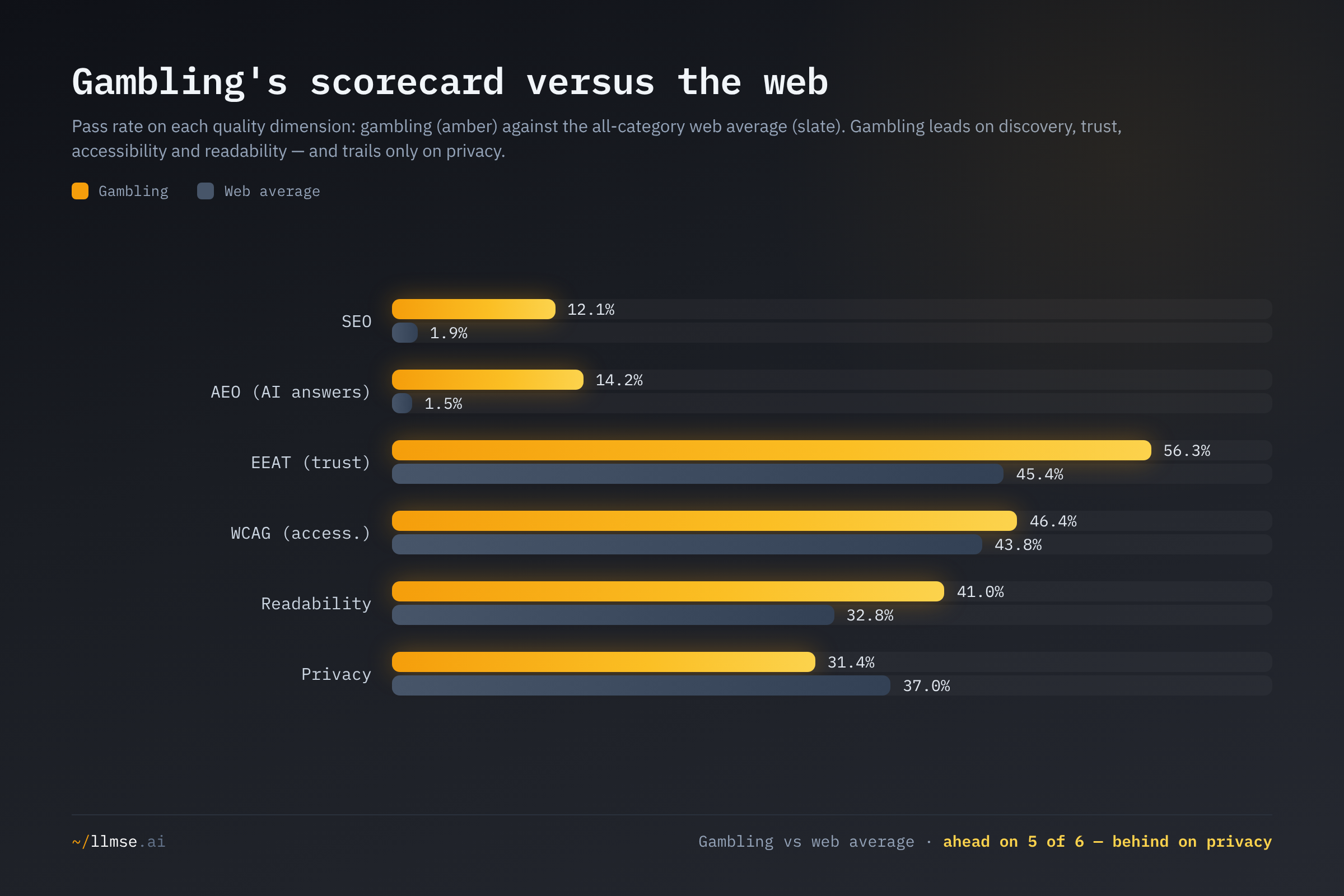
Gambling is above the web average on five of six dimensions, and the two it dominates are precisely the two that govern discoverability: search and AI answers. This is the tell. A spam vertical would show high SEO and low everything else. Gambling instead shows a profile consistent with professional, well-resourced web operations — sites that are easier to find, more trustworthy-looking, more accessible, and more readable than the typical website. The exception, privacy, is not a capability gap. It is a choice, and we return to it below.
SEO: The Most Optimized Industry on the Web
At 12.1%, gambling's technical-SEO pass rate is not just the highest of any category — it is more than double the runner-up (Adult, at 5.4%) and over six times the 1.9% web average. The rest of the leaderboard is a tight pack of regulated, high-value verticals where search visibility converts directly to revenue: Finance (3.9%), Crime (3.4%), Career (3.3%), Law & Government (3.0%). Gambling sits in a tier of its own.

The mechanism is competitive, not cosmetic. A revealing detail: gambling terms are largely absent from the published rankings of the most expensive paid-search keywords, which are dominated by insurance, loans, and legal services (WordStream). That is not because gambling traffic is cheap — it is because paid gambling ads are restricted in the first place. The competition is displaced into organic search, where there is no certification gate, and ranking for a term like "online casino" is worth enough that fast, crawlable, well-marked-up pages stop being optional. The 12.1% figure is the visible residue of an industry that has been forced to take organic SEO seriously for a decade.
AEO: Gambling Is Already Winning the AI-Answer Land Grab
If SEO is the established game, AEO — getting your content surfaced and cited by AI answer engines like ChatGPT, Perplexity, and Google's AI Overviews — is the new one. Gambling is winning it before most industries have noticed it exists. Gambling's AEO pass rate is 14.2%, against a 1.5% web average — a 9.5x multiple, the widest gap of any dimension we measured. The next category, Finance, sits at 4.5%.
AEO rewards the things affiliate-driven gambling content already does well: direct, extractable answers ("which casinos accept PayPal?"), comparison tables, statistics, structured data, and citations. These are not folk tactics — a Princeton-led study (KDD 2024) found that adding citations, quotations, and statistics can lift a source's visibility in generative-engine answers by up to 40%. The same content patterns that win "best of" search rankings are the patterns AI answer engines lift into their responses. Gambling didn't have to retool for the AI era — its existing SEO playbook happened to be an AEO playbook, and the head start is now measurable.
The irony is that gambling is racing for AI-answer slots the platforms are actively trying to withhold. An Ahrefs analysis of 146 million search results found Google's AI Overviews appear on about 20% of queries overall but only 1.4% of gambling queries — the second-most-suppressed category, just behind adult content. The major chatbots, meanwhile, officially prohibit facilitating real-money gambling. Gambling is therefore optimizing its content to be the most AI-citable in a vertical the AI platforms are trying to surface the least — and, as we note below, the suppression is leakier than it looks.
The Surprise: This Isn't the Spam You Expected
The lazy assumption about gambling sites is that they are thin, manipulative content farms — high on SEO tricks, low on everything real. The data contradicts it. Gambling beats the web average on EEAT (56.3% vs 45.4%), WCAG accessibility (46.4% vs 43.8%), and readability (41.0% vs 32.8%).
The trust result is the most striking. EEAT measures author credentials, organizational identity, editorial transparency, and citation behavior — exactly the signals Google's Search Quality Rater Guidelines demand of "Your Money or Your Life" (YMYL) content — topics that "could significantly impact the health, financial stability, or safety of people." Gambling is the definitive YMYL category: it involves users' money, and search engines scrutinize it accordingly. The industry has responded the way the incentives dictate — licensing badges, "about us" transparency, responsible-gambling disclosures, and review methodologies that read as credible to an automated grader. High EEAT here is not a sign of honesty; it is a sign of compliance with what ranks. But the result stands: structurally, gambling sites look more trustworthy than the median website.
The Privacy Exception: Collecting Identities, Cutting Corners
Then there is privacy, where gambling underperforms the web — 31.4% pass versus a 37.0% average, the only dimension where the industry falls behind. That is remarkable given what these sites handle. Licensed operators are legally compelled to collect deep identity and financial profiles: UK rules require verifying a customer's name, address, and date of birth before they gamble, EU anti-money-laundering law mandates customer due diligence on gambling transactions at or above €2,000, and UK operators now run financial-vulnerability checks triggered at as little as £150 of net deposits. They hold more sensitive personal and financial data than almost any consumer category online.
Yet on the privacy signals LLMSE checks — cookie-consent gating, the presence of privacy and cookie policies, tracker behavior, and data-processing disclosures — gambling lags. The Privacy grade distribution is bottom-heavy: 65% of graded gambling sites score F, against a long tail of consent banners and policies that are present but thin. Regulators have already noticed the gap: the UK ICO reprimanded Sky Betting & Gaming in 2024 for setting marketing cookies before users consented, Spain's AEPD and Croatia's AZOP have fined operators over data practices (AZOP issued a €380,000 fine for insecurely storing 2,078 copies of customers' bank cards), and a 2025 misconfiguration at Merkur exposed roughly 70,000 KYC files — ID scans and selfies included. The pattern is consistent with an industry that invests heavily in the parts of compliance that affect ranking and licensing and lightly in the parts that affect user data protection. The sites are optimized to be found and to look trustworthy; they are not optimized to protect the identities they are required to collect.
Why Gambling Out-Optimizes Everyone
Why would one industry pull so far ahead on organic discovery? The most plausible explanation is structural: gambling is locked out of the channels everyone else uses, so it pours everything into the one channel it can control.
Two constraints push in the same direction. First, paid advertising for gambling is heavily restricted. Google requires per-country certification and a valid local licence to run gambling ads — and in 2025 reclassified affiliate and aggregator sites as gambling-promoters subject to the same gate. Meta only serves gambling ads after explicit per-account authorization and proof of licensing. Several countries go further with near-total bans — Belgium (2023), the Netherlands (2023), and Italy's Decreto Dignità (2018) — and the UK bars TV betting ads around live sport. Second, gambling content is categorically brand-unsafe by default: in our index, roughly 99% of gambling sites carry a GARM brand-suitability grade of B (medium risk), and essentially none qualify as A (safe). Brand-safety filters that advertisers and ad exchanges apply to protect their inventory systematically exclude gambling. The combined effect is that the paid, programmatic, and social channels that subsidize most of the web are narrowed or closed to gambling operators.
What remains is organic search and affiliate marketing — and so gambling competes there with an intensity no other industry can match. That organic economy is large enough to float publicly traded, pure-affiliate companies: Better Collective reported €371m in 2024 revenue, and Gambling.com Group — a Nasdaq-listed business built almost entirely on ranking gambling content — posted $127m. The SEO and AEO leads are the predictable output of that pressure. This is a directional argument, not a proven cause, but it is consistent with every figure in this post: an industry that cannot buy its way to visibility engineers its way there instead.
The Map: Where Gambling SEO Runs Hottest
Gambling's optimization is not evenly distributed across markets. Breaking the category down by content language reveals that the headline 12.1% is pulled upward by a handful of hyper-optimized non-English markets.
| Market (language) | Gambling sites | SEO pass | AEO pass |
|---|---|---|---|
| English | 33,013 | 7.8% | 16.5% |
| Vietnamese | 7,543 | 30.9% | 24.8% |
| Indonesian | 7,395 | 7.7% | 4.8% |
| German | 3,144 | 12.3% | 15.2% |
| French | 2,484 | 19.1% | 11.9% |
| Turkish | 2,324 | 27.0% | 3.6% |
| Chinese | 2,302 | 1.6% | 1.0% |
| Spanish | 2,130 | 12.6% | 17.5% |
| Portuguese | 1,909 | 11.9% | 11.7% |
| Dutch | 1,278 | 12.6% | 20.7% |
| Polish | 1,213 | 20.6% | 15.4% |
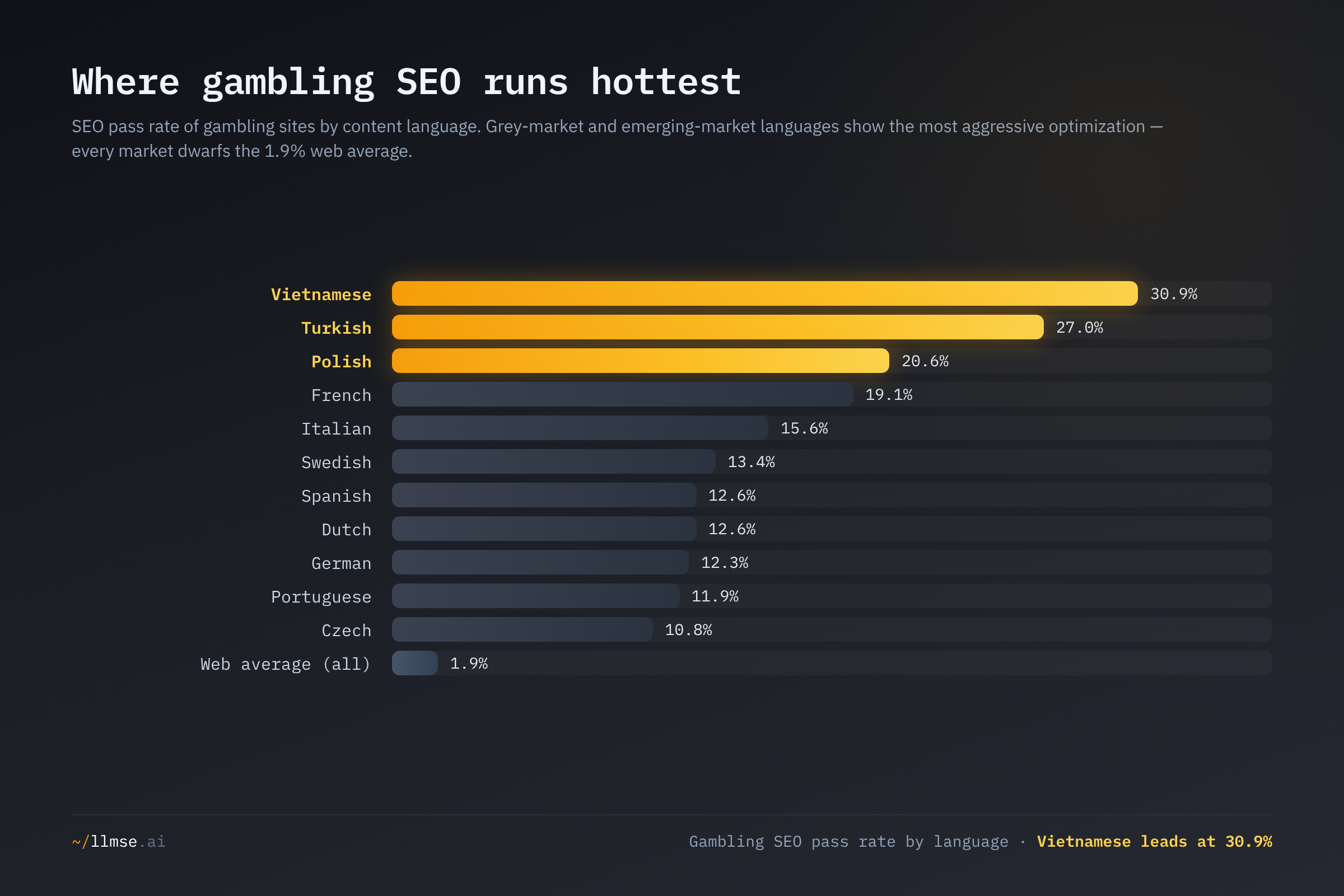
Vietnamese-language gambling sites pass SEO at 30.9%, Turkish at 27.0%, and Polish at 20.6% — multiples of the English-language gambling rate of 7.8%. Even that English figure, the floor among major markets, is four times the all-web average. The pattern in the highest-rate languages is consistent with aggressive affiliate and grey-market optimization in jurisdictions where gambling is restricted or unlicensed: where the activity is pushed to the legal margins, the web presence is pushed to the technical extreme. We state this as a correlation; the language of a page is a coarse proxy for its market, and these rates describe optimization, not legality.
Inside the Vertical: Casinos Lead the Commercial Core
Splitting gambling into its subcategories confirms that the commercial heart of the industry — not the regulators counted alongside it — drives the numbers.
| Subcategory | Sites | SEO | AEO | EEAT | Readability | Privacy |
|---|---|---|---|---|---|---|
| Casinos | 37,624 | 14.7% | 19.5% | 60.4% | 41.9% | 36.5% |
| Regulators & Organizations | 24,208 | 9.9% | 9.1% | 52.4% | 39.2% | 25.2% |
| Sports Betting | 7,834 | 13.1% | 16.9% | 62.3% | 51.4% | 31.5% |
| Lottery | 5,219 | 8.1% | 3.4% | 46.8% | 26.6% | 26.3% |
| Bingo | 2,244 | 1.6% | 2.0% | 27.9% | 43.7% | 21.4% |
| Poker | 1,336 | 8.2% | 8.5% | 61.1% | 39.3% | 39.3% |
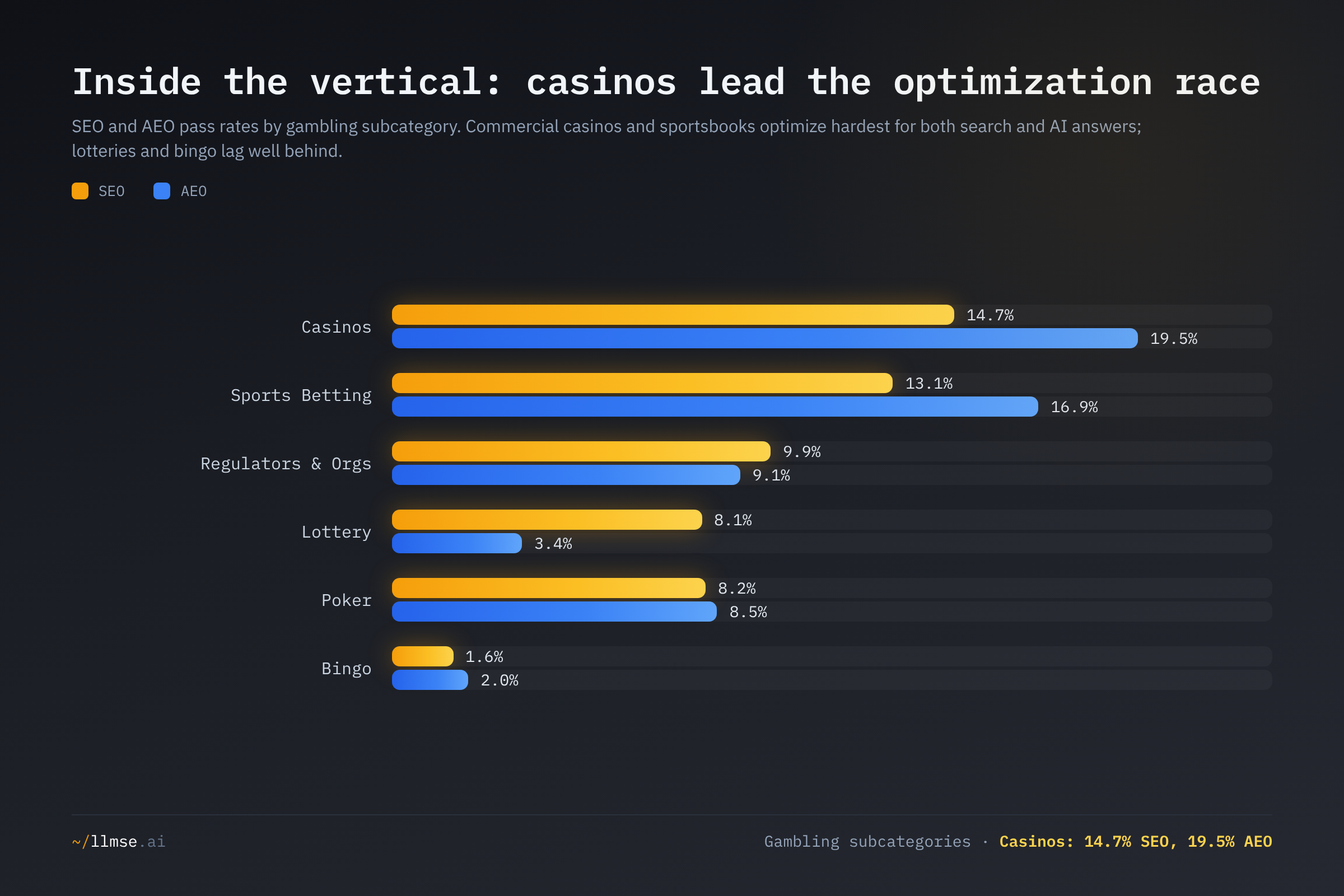
Casinos (37,624 sites) are the most optimized subcategory at 14.7% SEO and 19.5% AEO, with sportsbooks close behind (13.1% / 16.9%) and the most readable content of the group. The "Regulators & Organizations" bucket (9.9% SEO) and lotteries (8.1% SEO, just 3.4% AEO — many are official or state-run and feel no competitive pressure) sit well below. Bingo is the laggard at 1.6% SEO. The takeaway for the category average: strip out the 24,208 regulators and state lotteries, and the commercial operators that actually compete for players optimize even harder than the 12.1% headline suggests.
What's at Stake
- Discoverability of a high-harm product. Gambling's combined SEO and AEO dominance means it is disproportionately surfaced — in classic search results and, increasingly, in AI-generated answers. The most optimized category on the web is also one of the most addictive products on it: the Lancet Public Health Commission estimates around 80 million adults worldwide live with gambling disorder, and online casino and slots are the highest-risk format — 15.8% of users develop a disorder, versus 10.0% for land-based casinos. Optimization decides what the highest-risk product reaches the most people.
- A privacy liability sitting on top of identity data. A category that collects KYC-grade personal and financial data while scoring below the web average on privacy compliance is a breach and enforcement risk waiting to surface — and the user, not the operator, bears the downside.
- AI answer engines inherit the bias. Because gambling already leads AEO by nearly 10x, AI assistants that pull from well-structured, citation-rich pages will tend to over-surface gambling and affiliate content unless they apply YMYL-grade scrutiny. The leak is not hypothetical: when Investigate Europe and the Guardian tested seven chatbots across ten countries, roughly 75% of responses recommended unlicensed gambling sites, and all seven suggested ways to bypass the UK's GamStop self-exclusion scheme. The optimization gap becomes an answer-quality and harm problem.
- Brand-safety lock-in is self-reinforcing. Near-universal GARM-B status keeps gambling out of paid inventory, which deepens its reliance on organic and affiliate search, which widens the SEO/AEO gap further. The structure rewards exactly the behavior regulators worry about.
What Would Help
- AI answer engines: apply YMYL-grade provenance to gambling answers. Gambling's AEO lead means default retrieval over-weights it. Treat gambling queries like health and finance — prefer licensed, authoritative sources and surface responsible-gambling resources alongside affiliate content. Audit how often gambling affiliates appear in AEO-driven answers.
- Regulators: measure data protection, not just licensing. The privacy gap shows operators optimize for the compliance that gates a license, not the compliance that protects users. Make demonstrable consent and data-handling part of licensing review.
- Operators: close the privacy gap you can least afford. You collect more sensitive data than almost any consumer category and grade below the web on protecting it. Cookie-consent gating, complete privacy and cookie policies, and tracker discipline are cheap relative to the breach risk. Check your own grades with the Privacy analyzer.
- Advertisers and ad platforms: recognize the second-order effect. Brand-safety exclusion doesn't make gambling disappear — it pushes the spend into organic and affiliate search, where there is no brand-safety filter at all. Funding responsible-gambling content that actually ranks would do more than blocklists.
- Researchers and journalists: use the open data. Every figure here is reproducible by cross-referencing LLMSE's grade and category indices. The cross-industry quality report card and the earlier gambling web-quality analysis provide the broader context for how this category compares.
This analysis was conducted using LLMSE, which has classified over 3.3 million websites across SEO, EEAT, AEO, WCAG accessibility, readability, GARM brand safety, and privacy dimensions. Gambling figures reflect 78,490 classified gambling sites in the index as of June 2026. To analyze your own site across every dimension in this post, visit llmse.ai/classify.