The AEO Readiness Report: 98.5% of the Web Isn't Ready to Be Cited by AI
Update — 2026-06-29: This report has been rebuilt from a curated 25-homepage sample into a full-web aggregate, scored against LLMSE's current index of 3.4M classified URLs (up from ~1.4M at first publication). The original's hand-scored homepage table, per-site grades, and "average score of 42 / no site above a C" framing — homepage-only and unverifiable at scale — have been dropped in favor of reproducible AEO grade distributions across 3,337,318 graded URLs, 58 content categories, and detected CMS platforms. Three branded charts were added (grade distribution, readiness by category, readiness by platform). The core thesis — the web is not ready to be cited by AI answer engines — is substantiated and, at aggregate scale, far starker than the original implied: where the 25 flagship sites topped out at a C, the typical site on the web scores an F.
AI answer engines have quietly become one of the largest reading audiences on the internet — and they read differently than people do. Google's AI Overviews now appear on more than 20% of searches, AI Mode has surpassed one billion monthly users, and ChatGPT, Perplexity, and Gemini field hundreds of millions of queries a day, synthesizing answers from web pages instead of returning ten blue links. The downstream effect is already measurable: in the first four months of 2026, 68% of U.S. Google searches ended without a click (SparkToro / Similarweb clickstream data), up from 60% in 2024.
The prevailing assumption is that a site which ranks well, looks trustworthy, and is run by a recognizable brand is automatically in good shape for this shift. It is not. Being found by a keyword-matching crawler and being extracted and cited by an answer engine are different capabilities. AI systems reward content that states answers directly, defines its entities, backs claims with statistics and citations, and exposes machine-readable structure — and most of the web does none of this. Answer Engine Optimization (AEO) is the discipline of measuring and closing that gap.
We graded 3,337,318 URLs on AEO using LLMSE's automated analyzer — a 100-point framework that scores the ten content signals AI answer engines use to extract and attribute content — then cross-referenced the grades against content category and detected CMS. This is an aggregate of the whole index, applied uniformly by the same pipeline we run on every site, not a hand-picked sample of famous homepages. The original version of this report scored 25 flagship sites and found none cleared a C; this version asks the aggregate question those 25 sites cannot answer: across the entire web, how ready is content to be cited by AI?
The answer is that almost none of it is. Just 1.5% of graded URLs pass AEO (a grade of A, B, or C); 98.5% fail. A full 88.8% score an outright F, and only 68 sites in the entire index — 0.002% — earn an A. AEO is the lowest pass rate of any quality dimension LLMSE measures, on precisely the axis that is becoming most important. The web's AEO grades are not a bell curve with room to improve at the margins. They are a cliff.
The Data
AEO is one of six quality dimensions LLMSE grades web-wide. Placing it alongside the others shows just how isolated the failure is.
| Dimension | URLs graded (web-wide) | Web pass rate |
|---|---|---|
| SEO (technical) | 3,362,332 | 1.9% |
| AEO (AI answers) | 3,337,318 | 1.5% |
| EEAT (trust) | 3,358,202 | 45.4% |
| WCAG (accessibility) | 3,341,301 | 43.8% |
| Readability | 3,341,452 | 32.8% |
| Privacy | 3,335,565 | 37.0% |
Pass rates are computed over the population actually graded on each dimension — not every URL carries every grade, so the denominators differ slightly. AEO is the single hardest dimension to pass on the entire web — lower even than technical SEO (1.9%), and a fraction of the trust, accessibility, readability, and privacy pass rates. The dimensions that depend on visible, human-facing investment (trust signals, consent banners, plain prose) clear 30-45%; the two that depend on deliberate, machine-facing structure (SEO and AEO) sit below 2%. AEO is the newest of the six and the least addressed.
Methodology
This post makes quantitative claims, so the definitions and limits matter.
- Grades and "pass." Each URL is scored 0-100 by the AEO analyzer and assigned a letter grade with no E band: A (85-100), B (70-84), C (55-69), D (40-54), F (0-39). "Pass" means A + B + C — the same threshold used for SEO, EEAT, WCAG, and Privacy across LLMSE. For AEO, passing means a page carries enough extractable, attributable structure that an answer engine can lift and cite it with reasonable confidence.
- What the analyzer scores. AEO is a 100-point sum of ten weighted signals (detailed in the next section) plus a clickbait penalty of up to −10. The signals are detected by static HTML and JSON-LD analysis — question-style headings and FAQ accordions, short answer paragraphs, entity definitions, links to authoritative sources, statistics, schema completeness (Organization / Article / Author), visible freshness dates, and content depth.
- Classification basis. Category membership is assigned by LLM classification (58 categories); CMS/platform is detected from page fingerprints; each grade is an independent automated analyzer. Where a check is heuristic — notably FAQ and HowTo schema, which use neutral scoring (a page that has no FAQ content is not penalized for lacking FAQ schema) — the score reflects opportunity taken, not opportunity available.
- Cross-references are computed as set intersections (Redis
ZINTERCARD) between the AEO grade indices and each category or CMS index. All counts are aggregate; no individual site is identified or exposed. - Known limits. Pass rates are over graded populations, which are smaller than raw category or platform size. Detection is static — a snippet or schema injected client-side by JavaScript after load may be missed, which can understate well-built single-page apps. Counts are a live snapshot and drift as classification continues. CMS detection labels a stack, not a quality choice (jQuery, for example, is a JavaScript library used as a proxy for older sites, not a CMS). Russian-language sites are excluded from all breakdowns.
- Why these numbers differ from the original report. The first version (February 2026) hand-scored the homepages of 25 famous sites and reported an average of 42/100 with no site above a C. That sample was homepage-only, hand-curated, and not reproducible at scale, so it has been dropped. The aggregate is far harsher than those 25 sites implied — and consistently so: flagship brands' homepages are better structured than the median page on the web, so the curated sample's "tops out at a C" is the optimistic end of a distribution whose center is an F. The graded population also grew from ~1.4M to 3.4M URLs, and broadening coverage pulled most absolute pass rates down a few points as lower-visibility sites entered the index.
The Scorecard
The web-wide AEO grade distribution is the headline. It is not a curve with a long improvable tail; it is a near-vertical drop into F.
| Grade | Score band | Sites | Share |
|---|---|---|---|
| A | 85-100 | 68 | 0.002% |
| B | 70-84 | 3,175 | 0.10% |
| C | 55-69 | 47,038 | 1.41% |
| D | 40-54 | 324,568 | 9.73% |
| F | 0-39 | 2,962,469 | 88.8% |
| Pass (A+B+C) | 55-100 | 50,281 | 1.5% |
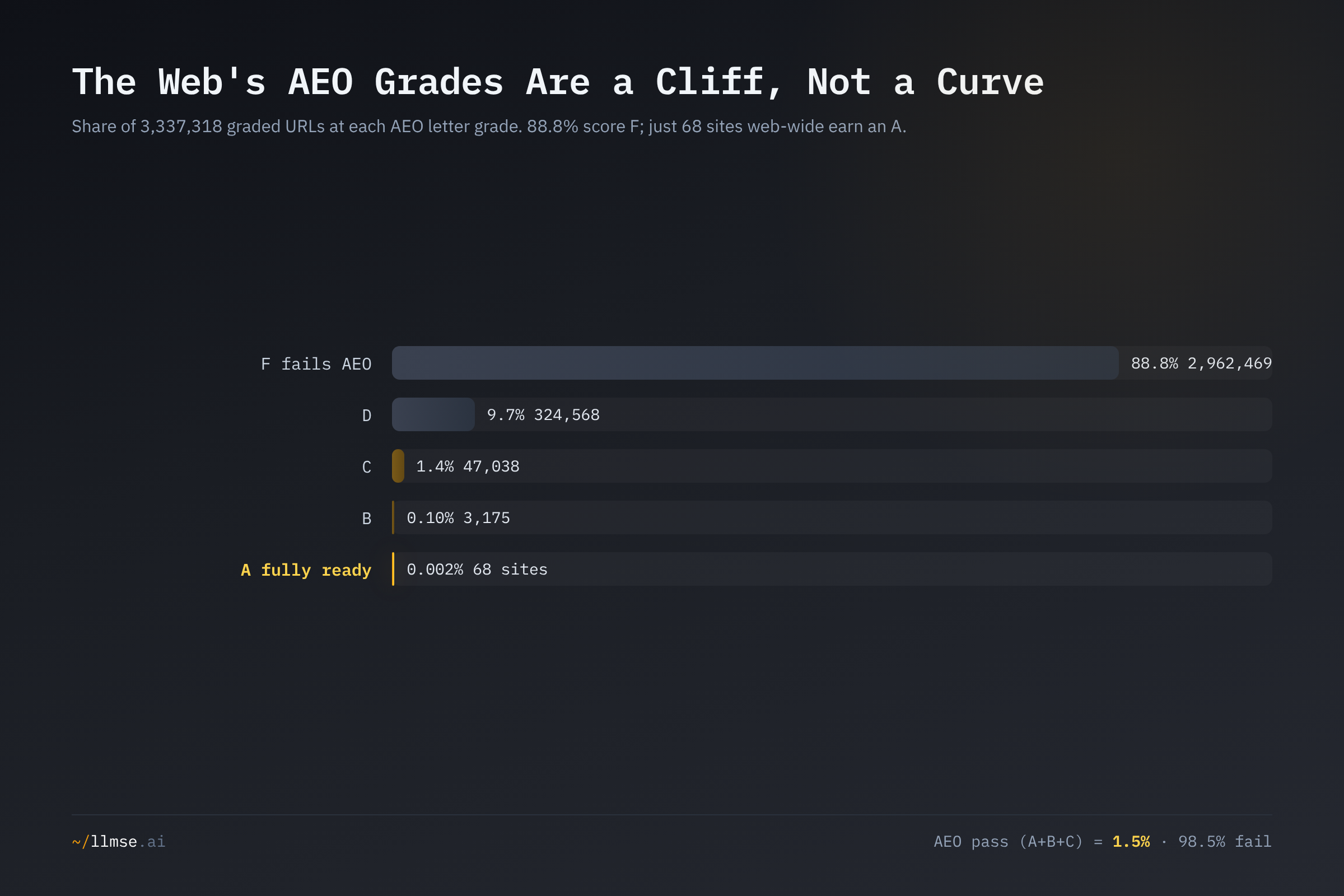
Nearly nine in ten graded URLs score an outright F, and the entire passing tier — A, B, and C combined — is 1.5% of the web. The "improvement" categories barely exist: 68 sites earn an A and 3,175 earn a B, meaning fewer than one site in a thousand reaches the top two grades. The mass of the web sits at F not because those pages are broken, but because they were never built to be extracted: no direct-answer blocks, no schema, no citations, no visible dates. This is the structural inverse of the trust and accessibility dimensions, where a plurality of the web passes. On AEO, passing is the rare exception — and that exception is concentrated, as the next sections show, in a handful of categories and platforms.
What the AEO Score Measures: The Signals AI Engines Reward
AEO is not a single test; it is a weighted sum of ten content signals, each tied to how generative engines select and attribute sources. Understanding the weights explains both what "ready" means and why so few pages clear it.
| AEO signal | Weight | What it rewards |
|---|---|---|
| Answer format detection | 15 | Extractable Q&A — question-style headings, FAQ accordions, interview format |
| Source citations | 13 | Links to authoritative domains, attributions ("according to…"), reference lists |
| FAQ schema | 12 | FAQPage structured data |
| Direct answer snippets | 11 | Short (under ~50-word) standalone answer blocks |
| Statistics & data | 10 | Percentages, figures, comparisons, study findings |
| Schema completeness | 10 | Organization + Article + Author structured data |
| Entity clarity | 9 | Definitions, "X is a…" patterns, glossaries |
| HowTo schema | 8 | HowTo structured data |
| Content freshness | 6 | Visible "last updated", copyright year, "as of 2026" dates |
| Topical authority | 6 | Depth — word count, heading breadth, internal + external links, ToC |
The weighting is not arbitrary. The two heaviest signals — answer formatting and source citations, 28 points between them — map directly onto what peer-reviewed research says moves the needle. The Princeton-led GEO study (KDD 2024) found that optimizing content for generative engines — specifically by adding citations, quotations, and statistics — can boost a source's visibility in AI-generated answers by up to 40%, with the most effective tactics varying by domain. AEO front-loads exactly those levers: citations (13 points), statistics (10), and the direct, quotable answer blocks that answer formatting (15) and snippets (11) detect.
This is also where AEO and Google's official guidance meet — with a useful nuance. Google is explicit that there is "no special schema.org structured data that you need to add" to appear in AI Overviews or AI Mode, and that "the best practices for SEO remain relevant for AI features." In other words, AEO is not about gaming a separate AI channel with secret markup. It is about doing the fundamentals well: Google's own structured-data documentation notes that structured data helps it "understand the content of the page, as well as to gather information about the web and the world in general," and that "defining more recommended features can make it more likely that your information can appear in Search results with enhanced display." The AEO score is a proxy for that readiness — extractable answers, clear entities, cited claims, and complete schema. The web fails it not because the bar is exotic, but because the fundamentals are rare.
One scoring detail tempers the gloom slightly: FAQ and HowTo schema (20 points combined) use neutral scoring — a page with no FAQ content is not punished for lacking FAQ schema. So the F-heavy distribution is driven by the active signals — answer formatting, snippets, citations, statistics, and schema completeness — that require deliberate effort, not by penalizing pages for content types they never claimed to have.
Readiness by Category: Gambling Is Ready, the Builders Aren't
AEO readiness is not evenly distributed. Cross-referencing AEO grades against the 58 content categories (showing those with 10,000+ graded sites) reveals a steep gradient, with one category running far off the front.
| Category | Sites graded | AEO pass rate |
|---|---|---|
| Gambling | 73,102 | 14.2% |
| Finance | 18,036 | 4.5% |
| Law & Government | 19,209 | 2.9% |
| Games | 43,808 | 2.9% |
| Shopping | 41,069 | 2.8% |
| Health | 76,295 | 2.2% |
| Education | 121,463 | 2.1% |
| Web average | 3,337,318 | 1.5% |
| Computer & Electronics | 395,110 | 0.6% |
| Reference | 44,517 | 0.1% |
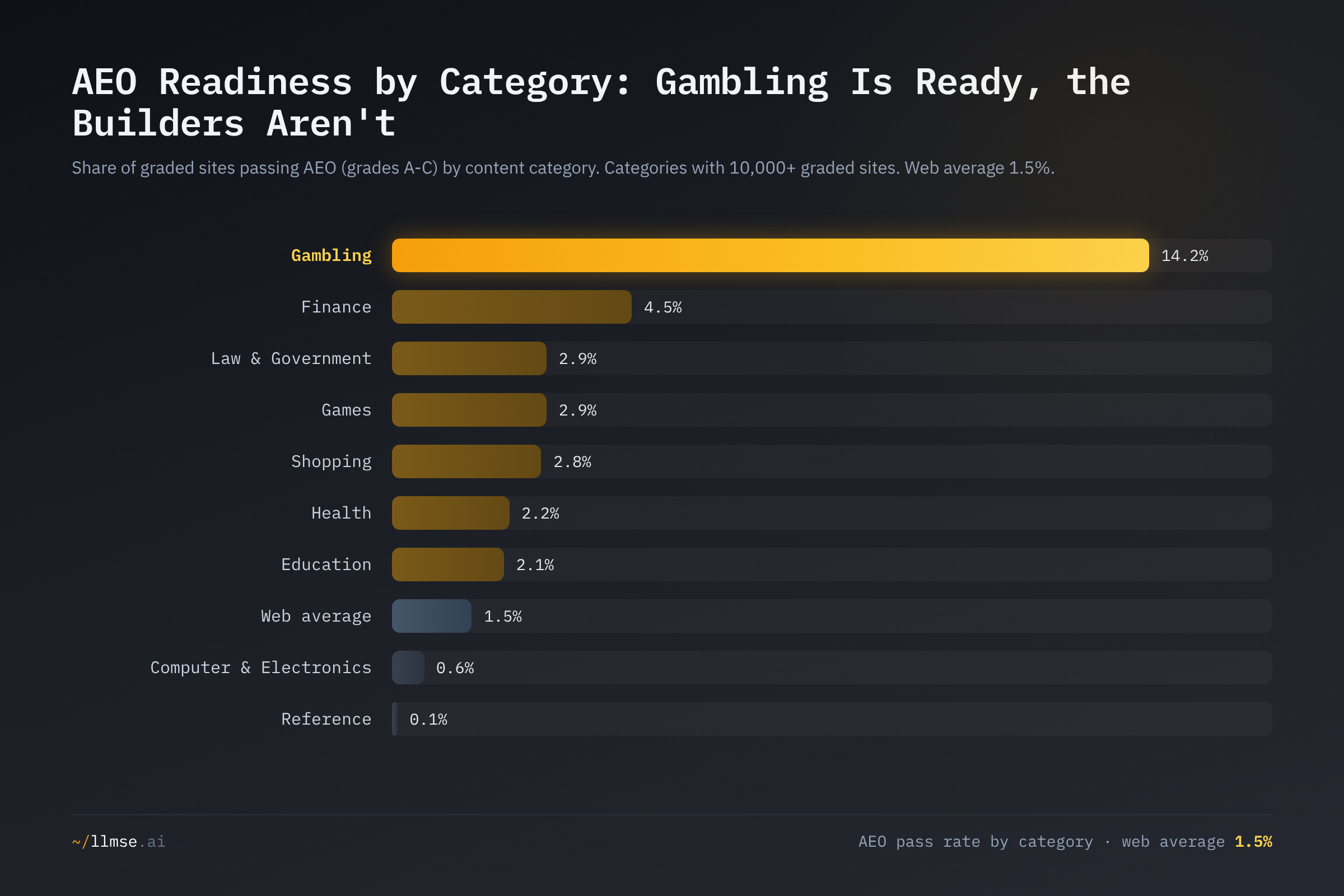
Gambling is the most AI-ready category on the web at 14.2% — nearly ten times the web average and more than three times the next category, Finance (4.5%). This is consistent with a structural explanation explored in depth in The House Always Optimizes: locked out of most paid and social ad channels, gambling operators compete almost entirely on organic and affiliate search, and the comparison tables, licensing FAQs, and statistics that win "best casino" rankings happen to be exactly what answer engines extract. The regulated, high-value verticals follow — Finance (4.5%), Law & Government and Games (2.9%), Shopping (2.8%) — where structured disclosures and comparison content are part of the business.
The most striking laggard is Computer & Electronics at 0.6% — the industry that builds the web is among the least ready to be cited by it. Below even the web average, and a fraction of gambling's rate, the sector's documentation, project pages, and developer blogs are written for humans arriving via links and error-message searches, not marked up for extraction. This is a recurring finding across LLMSE's data — the same sector lands last on AI-answer optimization in the cross-industry report card — and it underlines that AEO readiness reflects content choices, not technical capability. Which industries are positioned to win the resulting citation race, and how AEO interacts with trust signals, is the subject of the companion analysis, The AI Citation Readiness Gap.
Readiness by Platform: The CMS Is Part of the Story
The tooling a site is built on correlates with its AEO readiness — partly because some platforms ship structured-data and content features by default, and partly because platform choice is a proxy for how actively a site is maintained.
| Platform | Sites graded | AEO pass rate |
|---|---|---|
| Shopify | 15,245 | 6.0% |
| Drupal | 34,976 | 2.4% |
| WordPress | 1,046,908 | 2.3% |
| Medium | 288,201 | 2.0% |
| Tilda | 45,267 | 1.9% |
| Web average | 3,337,318 | 1.5% |
| Adobe Experience Manager | 115,147 | 1.2% |
| Squarespace | 26,287 | 1.0% |
| Joomla | 28,095 | 0.4% |
| jQuery (legacy) | 295,286 | 0.1% |
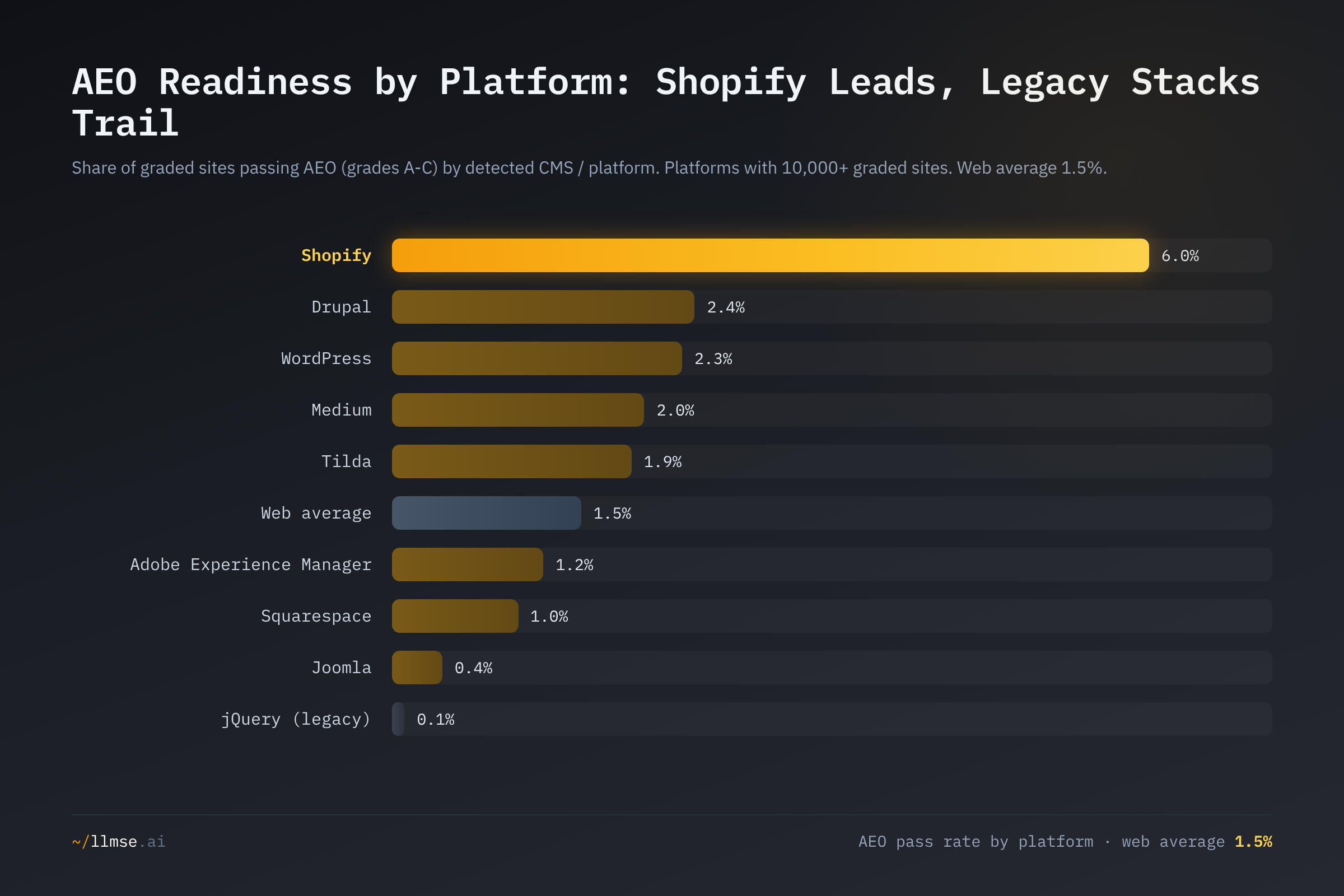
Shopify leads at 6.0% — four times the web average — while the dominant CMS, WordPress (over a million graded sites), sits at 2.3%, just above the line. Shopify's advantage is consistent with its content model: e-commerce product pages carry pricing, specifications, and FAQ blocks, and its app ecosystem includes schema and FAQ generators that emit citation-ready markup. WordPress, despite the web's largest schema-plugin ecosystem (Yoast, Rank Math, Schema Pro), only modestly beats average — installing a plugin is not the same as producing structured answers, and the platform's enormous long tail of lightly maintained sites pulls the rate down.
Legacy and developer-oriented stacks trail. Sites identified by jQuery — a proxy for the older, less-maintained web — pass at just 0.1%, and self-hosted CMSs like Joomla (0.4%) underperform. These are correlations, not causes: the platform does not write the content, and the gap is better read as a signal of how recently and deliberately a site was built than as a property of the framework itself. The companion citation-gap analysis examines the platform effect alongside server and language breakdowns in the context of who is positioned to win AI citations.
Why Almost Nobody Is Ready
Why would 98.5% of the web fail a test whose components Google says are just "SEO best practices"? The most plausible explanation is timing and incentives, not difficulty.
The web was built, page by page over three decades, for two readers: humans, and keyword-matching crawlers. Neither required answer-first formatting, entity definitions, or complete Organization-Article-Author schema. A page could rank and convert perfectly well as prose written for a person who would scroll, skim, and click. Answer engines introduced a third reader with different needs — and the installed base of the web predates it. The 88.8% sitting at F are not failing a test they tried to pass; they were finished before the test existed.
The incentive to retrofit is also weak and uneven, which is exactly what the category and platform gradients show. Where structured, extractable content already converts — gambling comparison pages, financial rate tables, e-commerce product specs — AEO readiness is comparatively high because the work was done for other reasons. Where content is written for human readers arriving via links — developer documentation, reference material, editorial prose — there has been little reason to add the machine-facing scaffolding, and the data shows almost none of it. Because the structure AEO rewards (citations, statistics, direct answers) is the same structure the Princeton GEO study found lifts AI visibility by up to 40%, the sites that retrofit it first inherit an advantage in a channel where, today, the competition is essentially absent.
What's at Stake
- Discoverability is migrating to a channel the web is not built for. With AI Overviews on 20%+ of searches and 68% of U.S. searches now ending without a click, the share of attention that flows through extraction-and-citation rather than blue links is rising. A 1.5% AEO pass rate means the overwhelming majority of sites are structurally invisible to that channel.
- Trust and brand do not transfer automatically. The web passes EEAT at 45.4% but AEO at 1.5%. Being authoritative and being citable are different capabilities; a trusted institution with unstructured pages can be summarized without attribution — or omitted from the answer entirely — while a thinner, better-structured page gets the citation.
- The optimized fringe will be over-surfaced. Because readiness is concentrated in a few categories (gambling at 14.2%, finance at 4.5%) while most of the mainstream web sits below 2%, naive retrieval will tend to over-represent whatever is best-formatted. The vacuum left by unready authoritative sources is filled by the verticals that optimized early.
- The first movers compound an advantage. AEO readiness is rare enough that modest, deliberate structuring — direct answers, schema, citations, visible dates — moves a page from the 88.8% that fail into a thin passing tier with little competition. The cost of the work is low relative to the scarcity of the result.
What Would Help
- Site owners: measure AEO as its own dimension, not as a byproduct of SEO. A strong search reputation does not imply readiness — the two dimensions correlate weakly and pass at 1.9% and 1.5% respectively. Run a dedicated check at llmse.ai/market/aeo and treat the result as independent of your rankings.
- Content teams: lead with the answer, then add the scaffolding. Open key sections with a 40-60 word direct answer, add a short FAQ where it fits, cite authoritative sources, and include concrete statistics. These are the heaviest-weighted AEO signals and the same levers the Princeton GEO study tied to a 40% visibility lift.
- Developers and technical publishers: add the machine-readable layer you skipped. Computer & Electronics passes AEO at 0.6%. Organization, Article, and Author schema, plus visible "last updated" dates, are cheap to add and move schema completeness, freshness, and entity clarity at once — without touching the prose your human readers came for.
- Platform and CMS vendors: ship AEO defaults, not just plugins. Shopify's 6.0% versus the WordPress long tail at 2.3% shows that built-in structured-data and FAQ features create a measurable readiness advantage across thousands of sites. Make complete, valid schema and answer-block templates the default, not an add-on.
- AI platforms: weight provenance over formatting. Because mainstream-sector readiness is uniformly low while a few verticals are high, retrieval that rewards structure alone will over-surface the optimized fringe. Prefer authoritative, AEO-ready sources within high-stakes topics rather than whatever is best formatted — a point developed further in The AI Citation Readiness Gap.
This analysis was conducted using LLMSE, which has classified over 3.4 million websites across SEO, EEAT, AEO, WCAG accessibility, readability, GARM brand safety, and privacy dimensions. AEO figures reflect 3,337,318 URLs graded on answer-engine optimization in the index as of June 2026. To analyze your own site's AEO readiness, visit llmse.ai/market/aeo or run a full multi-dimension scan at llmse.ai/classify.