The Trust Paradox: News Media Leads the Web on Trust Signals and Trails It on Accessibility — Across 71,700 Sites and Six Quality Dimensions
Update — 2026-06-29: Refreshed against LLMSE's current index of 3.4M classified URLs (up from ~1.5M at first publication) and expanded from four quality dimensions to six, adding AEO (AI-answer optimization) and Privacy. The News & Media population grew from 39,815 to 71,779 sites; refreshing every number, accessibility fell furthest (WCAG 43.9% → 34.7%, with nearly half of sites now scoring F), readability slipped from marginally above the web to marginally below, negative-sentiment share is now 1.7% (2.3x the web rate), and the original's curated "Sports News dominates quality" and "WordPress hits 77.7% EEAT" claims — both built on tiny early samples — have been dropped or corrected. The core thesis holds and is slightly stronger: news media's one decisive strength is trust signals (EEAT), and it trails the web on the fundamentals that decide whether the public can find, navigate, and understand the news. The two added dimensions land just above a low web baseline and do not change that shape.
News websites carry an obligation no other category does: the content they publish shapes what the public believes is true. So it is worth asking a question the usual flagship benchmarks cannot answer — not whether a handful of famous outlets are well-built, but whether the news web, in aggregate, across tens of thousands of sites, is good at the things that decide whether journalism actually reaches people.
The prevailing assumption is that news sites are at least competent at the basics. They employ editors, they have brands, they have been on the web for decades. If any category should be findable, accessible, and trustworthy, it is the one whose entire purpose is public information. And on one of those axes, the data agrees emphatically. On the others, it does not.
We cross-referenced 71,779 news and media sites in LLMSE's index against six quality dimensions — SEO, AEO (optimization for AI answer engines), EEAT (trust signals), WCAG accessibility, readability, and privacy compliance — using the same automated graders applied uniformly across 3.4 million classified URLs. No hand-picked sample of marquee outlets; the long tail of local papers, niche outlets, and digital-first publishers is in the denominator.
News media leads the web on exactly one dimension — trust signals (EEAT, 56.3% vs 45.4%) — and trails it on the ones that decide whether the public can actually use the news. Accessibility is the worst: 34.7% pass WCAG versus a 43.8% web average, and nearly half of all news sites (48%) score an outright F. Only 1.7% pass technical SEO. And the irony runs deeper: news scores highest on the structural signals of credibility precisely as public trust in news falls to 37% — a record low. The pages look trustworthy to a grader. The audience is no longer convinced.
The Data
The News & Media category spans general news websites, digital-first outlets, traditional and national newspapers, and a long tail of specialist verticals (sports, business, weather, opinion, investigative journalism). Every grade below comes from LLMSE's automated pipeline applied uniformly across the index — not a curated list of flagship titles.
| Dimension | News sites graded | News pass rate | Web average |
|---|---|---|---|
| SEO | 70,957 | 1.7% | 1.9% |
| AEO (AI answers) | 70,489 | 1.8% | 1.5% |
| EEAT (trust) | 70,846 | 56.3% | 45.4% |
| WCAG (accessibility) | 70,563 | 34.7% | 43.8% |
| Readability | 70,566 | 31.4% | 32.8% |
| Privacy | 70,446 | 40.1% | 37.0% |
Pass rates are computed over the population actually graded on each dimension, not every indexed URL. News leads the web on three dimensions (EEAT, AEO, privacy) and trails on three (SEO, WCAG, readability) — but the magnitudes are lopsided: the EEAT lead is +10.9 points and the WCAG deficit is −9.1 points, while the AEO and privacy "wins" are slivers above a very low bar (more on that below). On content tone, news is the most negative mainstream sector on the web: 1.73% of news content reads as negative versus a 0.747% web average — a 2.3x ratio — even though the same sites are overwhelmingly brand-safe (98.5% carry a GARM "safe" grade, against 90.2% web-wide). Negative tone is not unsafe content; it is the subject matter.
Methodology
This post makes quantitative claims, so the definitions and limits matter.
- Grades and "pass." Each site is graded A–F by a dedicated automated analyzer (there is no E grade). "Pass" means A+B+C for SEO, AEO, EEAT, WCAG, and Privacy, and A+B for Readability (a Flesch Reading Ease score of roughly 50+, ≈ 8th-grade level or below). SEO grades technical fundamentals; AEO grades answer-extractability and AI-citation signals (direct answers, schema, statistics, source citations); EEAT grades experience/expertise/authoritativeness/trust signals; WCAG covers automated accessibility checks (~30–40% of WCAG 2.1 Level A — full conformance requires manual testing); Privacy grades consent gating, policy presence, and tracker behavior. GARM "safe" is the A grade only (brand-suitability). Sentiment is a separate content classifier with Good / Neutral / Bad labels.
- Classification basis. Category and subcategory membership is by LLM classification; each grade is an independent automated analyzer. CMS detection (WordPress, Medium) is by HTML-signature matching.
- Cross-references are computed as set intersections (Redis
ZINTERCARD) between the News & Media index and each grade, subcategory, sentiment, or CMS index. Subcategory and CMS quality figures are reproducible three-way intersections (category ∩ subcategory/CMS ∩ grade). All counts are aggregate; no individual site is identified. - Known limits. Pass rates are over graded populations, which are smaller than the raw category size. Subcategories below ~2,000 graded sites (Sports News, Business News) are flagged as small samples and read as indicative. The Readability grade uses Flesch scoring, calibrated for English, so cross-language readability is unreliable and we avoid it. Counts are a live snapshot and drift as classification continues. Russian-language sites are excluded from all breakdowns.
- Why these numbers differ from the 2026-03 original. The graded population grew from ~1.5M to ~3.4M URLs and the News & Media count rose from 39,815 to 71,779. Early grades were biased toward higher-quality, more-visible sites, so most absolute pass rates fell as coverage broadened — WCAG fell furthest, from 43.9% to 34.7% (web-wide accessibility also fell, 52.6% → 43.8%). Two dimensions are new since the original (AEO, privacy). And two original claims that rested on small early samples are dropped or corrected: "Sports News dominates three of four dimensions" (its 60.7% readability and 7.0% SEO do not survive a larger sample) and "WordPress news hits 77.7% EEAT, the highest CMS-sector combination" (now 65.5%, and Medium edges it). The original's standalone server-infrastructure section is also dropped as tangential.
The Scorecard
Plotting news media against the all-category web average across every dimension produces a single tall spike and a row of shortfalls.
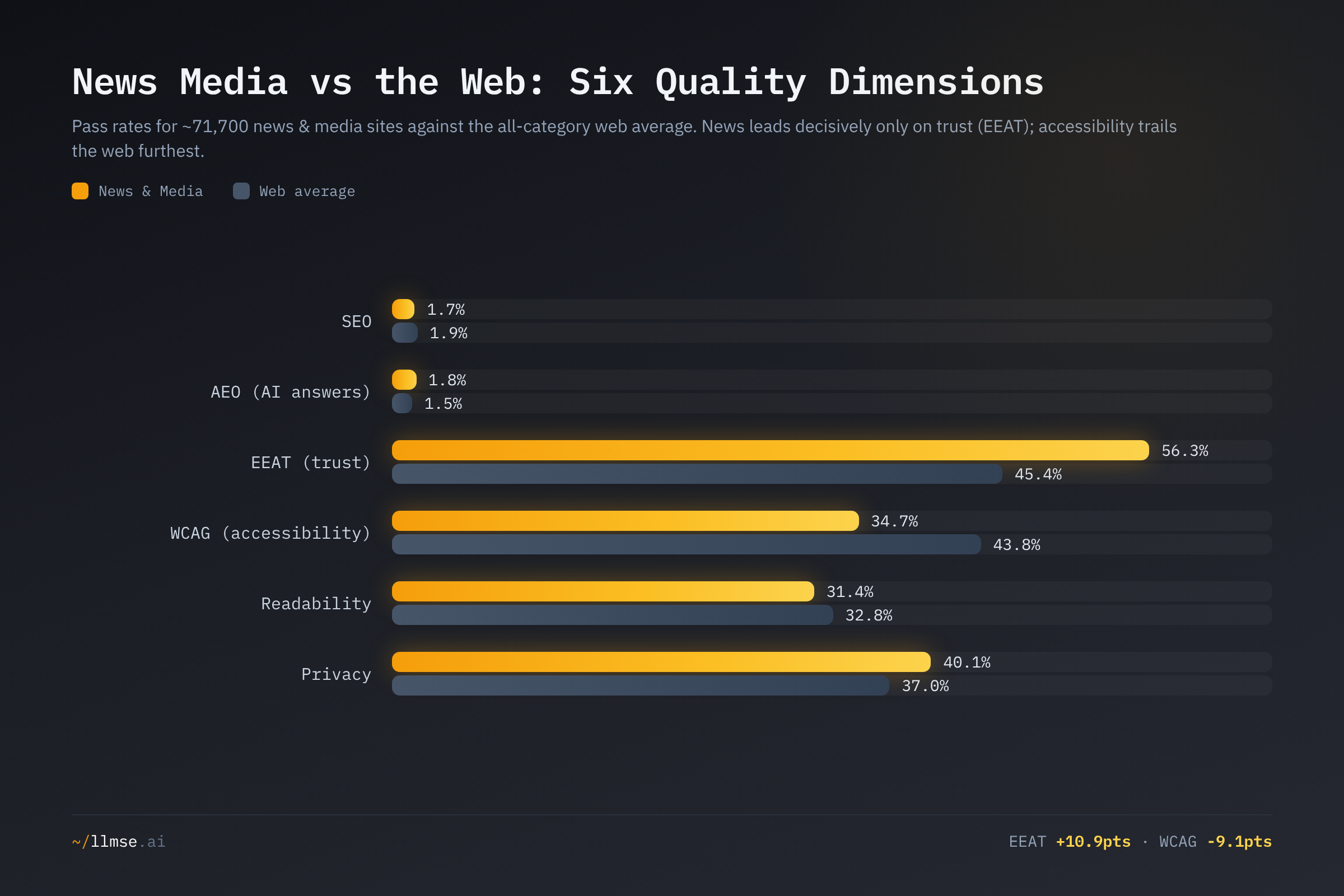
News media's profile is dominated by one strength — trust signals — surrounded by mediocrity. EEAT is the only dimension where news clears the web average by a wide margin. AEO (1.8% vs 1.5%) and privacy (40.1% vs 37.0%) are technically above the web, but both are cold comfort: AEO at 1.8% is barely off the floor that almost the entire web shares, and the privacy "pass" is overwhelmingly bare-minimum — of the 40.1% that pass, the vast majority sit at grade C, with 59% of news sites scoring an outright F on privacy. Strip the rhetorical generosity and the honest reading is the one the original post made, now sharper: news media is good at looking credible and weak at nearly everything that governs whether the public can find a story, read it, and navigate it. The rest of this report resolves that tension dimension by dimension.
EEAT: The One Real Strength, at the Worst Possible Time
News media passes EEAT at 56.3% — 10.9 points above the web average and its single decisive win. EEAT measures the structural signals of credibility: author bylines and credentials, organizational identity, editorial transparency, mastheads, contact and ownership disclosure, and citation behavior. These are exactly the artifacts a news organization produces by default. Google's Search Quality Rater Guidelines single out "Your Money or Your Life" content — information that can affect health, finances, safety, or civic decisions — for heightened scrutiny, and general news sits squarely in that zone. The sector has the editorial scaffolding the rater guidelines reward, and the grader sees it.
The strength is real but not uniform: top-tier trust (an A grade) is rare at 5.0% of graded news sites, roughly the web's own A-rate. What lifts news above the web is the broad B/C band — the structural basics most outlets carry. That is the on-page picture.
The off-page picture is the paradox. News scores highest on credibility signals at the precise moment audiences have stopped extending credibility. The Reuters Institute's Digital News Report — the most-cited cross-national trust benchmark — finds that, having held at 40% for three years, global trust in news fell to 37% in 2026, the lowest since measurement began in 2015; in the United States, only a quarter (25%) of people say they trust the news most of the time. EEAT grades whether a page presents the markers of trustworthiness; it cannot grade whether the public believes them. The data is consistent with a structural mismatch: the sector has optimized the signals an algorithm reads and lost the trust a reader grants. That is descriptive, not causal — but it is the central tension of the modern news web.
Accessibility: The Democratic Deficit Got Worse
News media passes WCAG accessibility at 34.7% — 9.1 points below the web average, and the gap widened as coverage broadened (it was 43.9% at first publication). This is now the sector's worst result relative to the web, and the grade distribution is bleak: 48% of news sites score an outright F on accessibility — up from one-in-three in the original — versus 17.4% A grades.
The stakes here are not abstract. News is how the public learns about elections, emergencies, public-health guidance, and government action; accessibility decides whether people who use screen readers, keyboard navigation, or magnification can get that information at all. WCAG 2.1, a W3C Recommendation, is the operative standard, and accessibility is increasingly a legal obligation rather than a courtesy: the European Accessibility Act applies from 28 June 2025 and covers consumer-facing digital services including websites, with subscription-based news products explicitly in scope.
The comparison that should sting most: in our companion cross-industry report card, Law & Government clears WCAG at 43.9% — nine points ahead of the news sites that hold it accountable. Citizens with visual or motor impairments can navigate government pages more easily than the journalism scrutinizing those governments. The plausible mechanism is structural, not deliberate: breaking-news tickers, auto-playing video, social embeds, infinite-scroll feeds, and advertising-dense layouts generate exactly the patterns automated accessibility checks fail — complexity that text-heavy reporting never needed.
Discovery: Harder to Find, Just as Search Sends Less
Only 1.7% of news sites pass technical SEO — below the 1.9% web average — and a staggering 95.5% score an F. Out of 70,957 graded news sites, just ten earn an A. News organizations historically leaned on brand recognition, direct navigation, and social distribution rather than technical search hygiene, and the structural debt is now visible in the grades.
The timing is brutal, because the channels news relied on are contracting at once. Per the Reuters Institute / Chartbeat trends data reported by Press Gazette, global Google search referrals to publishers fell by roughly a third in the year to November 2025, and Google Discover referrals dropped 21% — with US publishers down 38% on search. As AI Overviews and AI Mode absorb more queries, the click that used to reach the article increasingly doesn't. Sites that are technically hard to crawl and weakly marked up are least equipped to defend the visibility they have left.
News's AEO rate — optimization for AI answer engines — is 1.8%, marginally above the 1.5% web average but still near the floor: most news content lands at grade D (some structure, not pass-level). That marginal lead is not a moat. News-SEO specialists have argued for years that the technical groundwork is non-optional: Barry Adams notes that news articles must rank immediately, before Google finishes rendering, so structured data has to live in the raw HTML rather than load via JavaScript. Google's own Publisher Center best practices ask for clean NewsArticle markup, accurate publish/modify dates, prominent <h1> headlines, and story-specific images marked up with Article structured data. These are the same signals AEO rewards — direct answers, schema, citations — and the same ones an SEO grader checks. The sector that most needs to be found and cited has the least of them.
Inside the Sector: Trust Up, Access Down in Every News Type
Splitting News & Media into subcategories shows the headline pattern is not an averaging artifact — it repeats in nearly every type of news.
| Subcategory | Sites | SEO | AEO | EEAT | WCAG | Read. | Privacy |
|---|---|---|---|---|---|---|---|
| News Websites | 17,445 | 1.4% | 2.6% | 61.1% | 37.0% | 22.3% | 48.3% |
| Online News | 12,338 | 1.7% | 1.7% | 44.6% | 46.1% | 28.7% | 37.2% |
| Newspapers | 6,698 | 1.1% | 2.9% | 70.4% | 22.2% | 26.4% | 45.2% |
| National Newspapers | 5,044 | 2.0% | 0.9% | 61.3% | 25.0% | 43.4% | 34.8% |
| Sports News* | 1,288 | 3.0% | 2.0% | 71.2% | 26.5% | 29.5% | 49.9% |
| Business News* | 1,285 | 2.2% | 1.7% | 62.2% | 37.2% | 37.2% | 41.8% |
| Sector average | 71,779 | 1.7% | 1.8% | 56.3% | 34.7% | 31.4% | 40.1% |
*Small samples (<1,300 graded sites) — read as indicative.
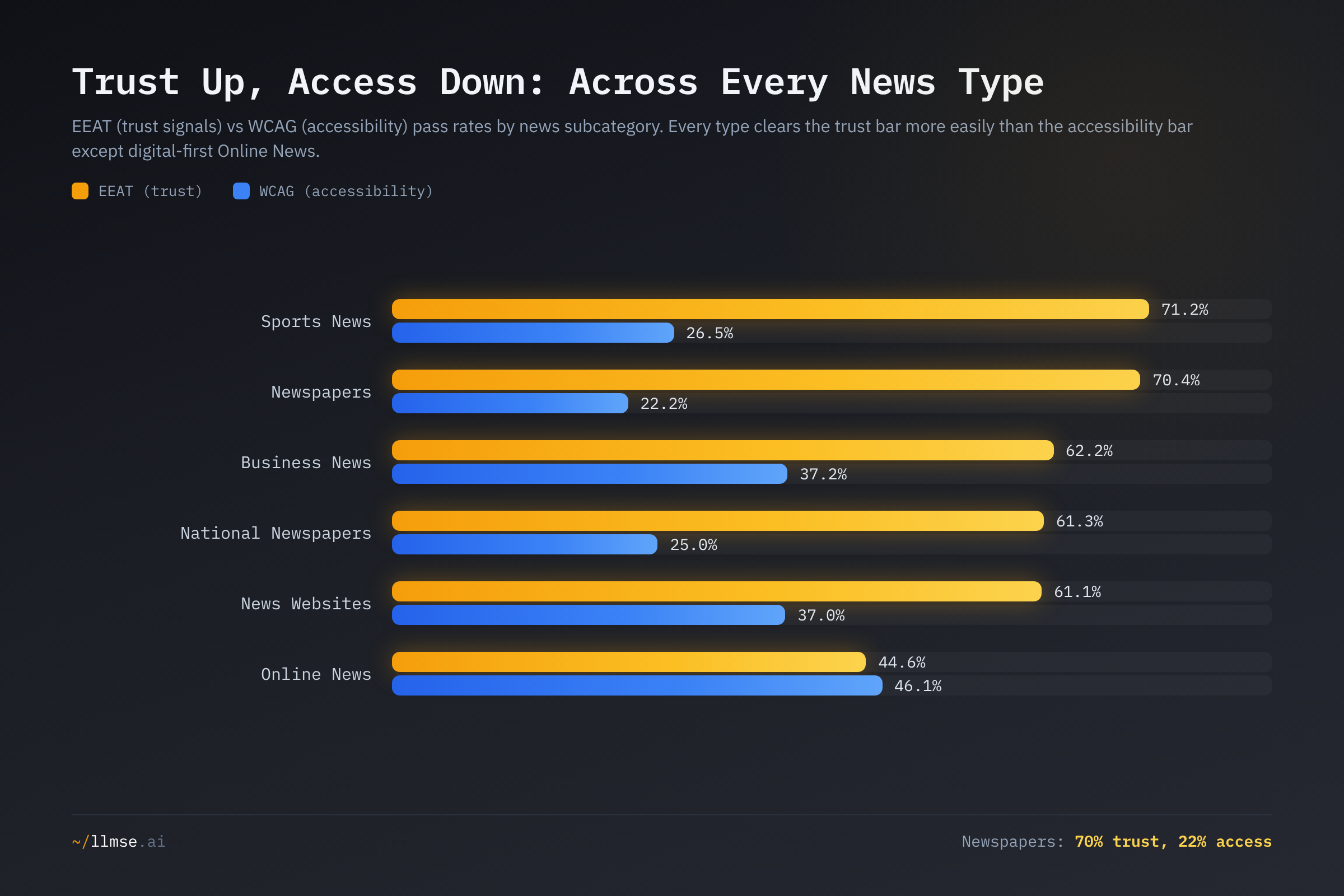
In five of six subcategories, trust comfortably beats accessibility — and the cleanest case is the most traditional one. Newspapers post the highest trust among the substantial subcategories (70.4% EEAT, a hair behind small-sample Sports News at 71.2%) and the lowest accessibility on the board (22.2% WCAG): decades of institutional credibility — mastheads, editorial boards, bylines — translate directly into the signals EEAT measures, while their legacy, print-first codebases produce the layouts WCAG penalizes. The single exception is Online News, where the relationship flips: digital-first outlets have the weakest trust signals (44.6%, near the web average) but the strongest accessibility (46.1%) — newer, more standardized publishing stacks clear the static checks even as these outlets haven't yet built the institutional trust scaffolding traditional papers inherited.
This is also where the original post's most dramatic claim falls apart. It reported Sports News "dominating" with 7.0% SEO and 60.7% readability; on the current, larger sample those collapse to 3.0% and 29.5%. Sports News still posts strong trust (71.2% EEAT) and weak accessibility (26.5% WCAG) — the same shape as everything else — but it is not a quality outlier. The early figure was a small-sample mirage.
Sentiment: The Web's Most Negative Mainstream Sector
News content is, by subject, negative more often than almost anything else online.
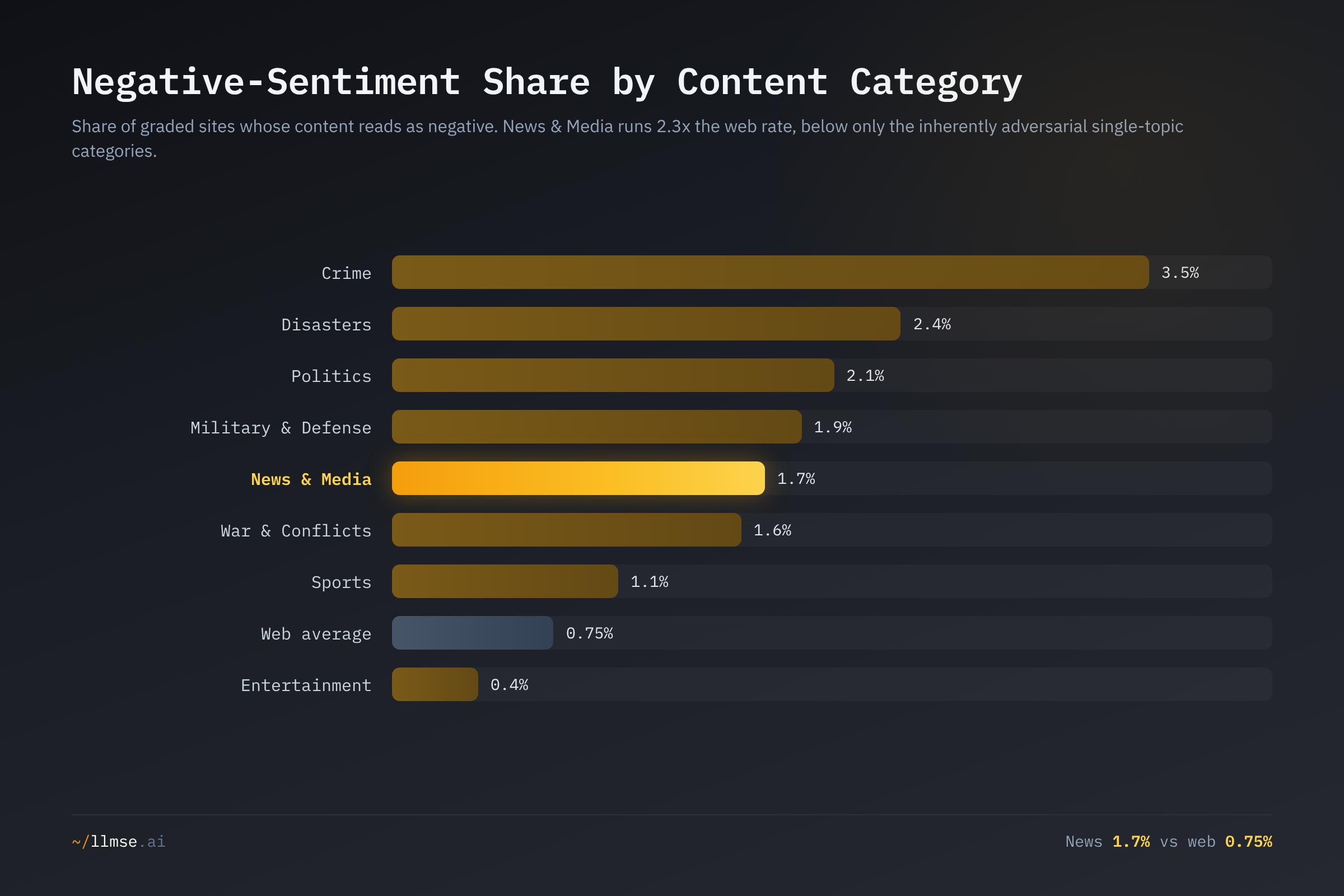
At 1.73% negative-sentiment share, News & Media runs 2.3x the web-wide rate of 0.747% — and among broad mainstream content sectors it is the most negative of all. It trails only the single-topic categories whose entire remit is adversarial: Crime (3.5%), Disasters (2.4%), Politics (2.1%), and Military & Defense (1.9%). That ordering is the point — news reads negative because it covers conflict, disaster, crime, and controversy by definition, not because its operators are doing anything wrong. Crucially, negative tone is not the same as brand-unsafe content: 98.5% of news sites still carry a GARM "safe" grade, well above the 90.2% web average. The sentiment classifier is reading the mood of the reporting; the brand-safety grader is reading whether the content is suitable for advertising. News is tonally heavy and commercially safe at the same time — a distinction that matters for the persistent finding that audiences associate news with worry about what is real online and fatigue with the news cycle.
The Platform Layer: WordPress and Medium Both Inherit the Profile
WordPress powers 39.7% of news sites (28,518) — close to its share of the wider web — and Medium accounts for 10.5% (7,525). Both platforms reproduce the sector's signature shape rather than escaping it.
| Metric | WordPress news | Medium news | Web average |
|---|---|---|---|
| Sites | 28,518 | 7,525 | — |
| SEO | 1.9% | 1.5% | 1.9% |
| AEO | 2.2% | 3.7% | 1.5% |
| EEAT (trust) | 65.5% | 68.8% | 45.4% |
| WCAG (accessibility) | 36.8% | 23.4% | 43.8% |
| Readability | 28.6% | 28.9% | 32.8% |
| Privacy | 49.0% | 53.7% | 37.0% |
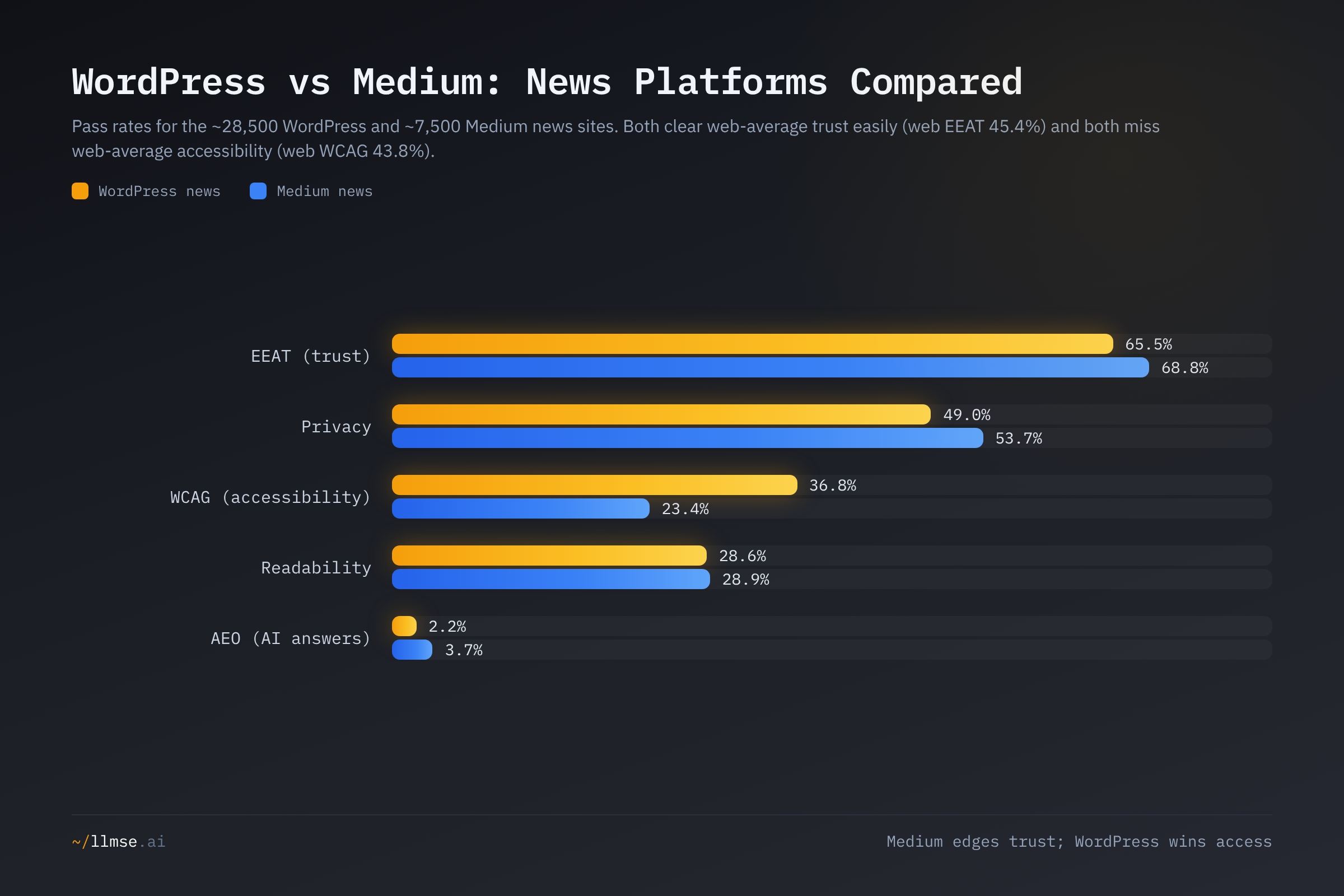
Both platforms beat the web on trust and lose to it on accessibility — the sector profile in miniature. WordPress and Medium news sites pass EEAT at 65.5% and 68.8% (versus 45.4% web-wide): the editorial defaults both platforms ship — author pages, categories, organizational identity — generate the trust signals EEAT rewards. But both fall below the 43.8% web accessibility bar, and Medium is the worse of the two at 23.4% WCAG — its minimalist, JavaScript-driven reading interface clears fewer static accessibility checks than WordPress's more conventional themes (36.8%). This corrects the original post directly: WordPress news does not hit 77.7% EEAT, and it is no longer the trust leader between the two — Medium narrowly is. Neither platform's defaults make news accessible out of the box, which is why the sector's accessibility deficit is so consistent across the publishers built on them.
What's at Stake
- News is getting harder to find exactly as search sends less of everyone's traffic. A 1.7% SEO pass rate and a near-floor 1.8% AEO rate mean news is poorly positioned for both classic search and AI answers — at a moment when publisher search referrals are down roughly a third year-on-year. The distribution channels news leaned on are shrinking, and the technical groundwork to defend the rest is thin.
- Accessibility is now a legal exposure, not just a public-interest gap. With 48% of news sites scoring an F on WCAG and the European Accessibility Act in force since 28 June 2025, subscription news products in the EU face compliance risk on top of the democratic deficit of excluding disabled readers from civic information.
- The sector's one strength is a signal, not a guarantee. News leads the web on EEAT trust signals while public trust sits at a record-low 37%. On-page credibility markers are necessary but plainly not sufficient; the gap between structural trust and audience trust is the sector's defining problem.
- AI answer engines will inherit a thin, negative corpus. News is the most negative mainstream content sector (2.3x the web's negative-sentiment rate) and only marginally AI-answer-ready. Engines that retrieve from whatever is best structured will tend to surface the optimized fringe over careful reporting unless they weight provenance — and the news that does get cited skews toward conflict and crisis.
What Would Help
- Newsrooms and publishers: treat accessibility as core editorial infrastructure. A 34.7% WCAG pass rate — 48% scoring F — is the sector's worst result, and the EAA now makes it enforceable for subscription products. Semantic headings, alt text on photojournalism, keyboard-navigable menus, and captioned video are cheap relative to the legal and civic risk. Audit your own grades with the accessibility analyzer.
- SEO and product teams: rebuild the technical foundation before the traffic is gone. At 1.7% SEO and a 95.5% F rate, news is structurally hard to find. Follow Google's Publisher Center best practices — clean
NewsArticlestructured data in raw HTML, accurate dates, real<h1>headlines — which simultaneously improve AEO readiness as AI answers replace clicks. - Editors: protect the trust signal you lead on, and close the gap to actual trust. News's 56.3% EEAT is its only decisive advantage. As AI-generated content proliferates, visible author credentials, editorial-standards pages, corrections policies, and ownership transparency are how journalism stays distinguishable from synthetic text — and how it begins to rebuild the audience trust now at a record low.
- Platform and CMS vendors: ship accessible news themes by default. WordPress (36.8% WCAG) and especially Medium (23.4%) both leave news sites below the web average. The single highest-leverage fix for the sector is accessible defaults — semantic templates, focus management, and ARIA-correct components — in the platforms that publish most of the news web.
- AI platforms and researchers: weight provenance for news, and use the open data. Because news is only marginally AI-answer-ready and tonally negative, naive retrieval will mis-surface it; prefer authoritative, accessible sources for civic and YMYL queries. Every figure here is reproducible by intersecting LLMSE's category, subcategory, CMS, and grade indices — see the cross-industry quality report card for how news compares to 15 other sectors.
This analysis was conducted using LLMSE, which has classified over 3.4 million websites across SEO, EEAT, AEO, WCAG accessibility, readability, GARM brand safety, and privacy dimensions. News & Media figures reflect 71,779 classified news and media sites in the index as of June 2026. To analyze your own site across every dimension in this post, visit llmse.ai/classify.