The E-Commerce Platform Quality Index: Shopify, WooCommerce, Magento, OpenCart and the Trade-Offs Behind Each
Update — 2026-06-29: Refreshed against LLMSE's current index of 3.4 million classified URLs (up from ~1.5M at first publication) and expanded from four quality dimensions to seven, adding AEO (AI-answer optimization), Privacy, and GARM brand safety. The larger graded population flipped the leaderboard. Shopify's EEAT surged to 91.8% and now leads trust (the original had OpenCart on top at 97.1%); WooCommerce (3.8%) overtook a collapsing BigCommerce (4.8%→1.5%) for the SEO lead; and Wix's accessibility improved sharply — the original's "88% WCAG failure" is now a ~64% failure rate, with 25.2% of Wix sites passing. Magento remains the commerce accessibility leader, OpenCart still posts the worst SEO (0.2%) and the best readability, and the demographic / language / server cross-tabs from the original were dropped because they are tangential to a quality index. The core thesis — no platform wins everything — holds, and the two discovery axes (SEO and the new AEO) sharpen it.
Every "Shopify vs. WooCommerce" article you have ever read is built on opinion: feature checklists, pricing tables, and the lived experience of a developer who has shipped on one platform and not the others. None of them answer the question that actually decides whether a store gets found, trusted, and understood: when real merchants build on these platforms, which ones produce higher-quality websites — and on which axis of quality?
The intuition is that there is a single "best" platform, and that the managed, hosted options (Shopify, BigCommerce) should win across the board because they bake in good defaults. That intuition does not survive contact with the data. Quality is not one axis; it is at least seven — technical SEO, AI-answer optimization, trust signals, accessibility, readability, privacy, and brand safety — and they correlate only loosely. A platform can post the web's highest trust scores while being among its least findable, or write the clearest product copy while failing accessibility more completely than anything else measured.
We took the 33,422 sites in LLMSE's index detected on a dedicated e-commerce platform — Shopify, Magento, OpenCart, PrestaShop, WooCommerce, and BigCommerce — and cross-referenced each platform against all seven graded dimensions, then benchmarked the results against the all-site web average and against the website builders (Squarespace, Wix, Webflow) and WordPress for context. Every grade comes from LLMSE's automated analysis pipeline applied uniformly across the index, not a hand-picked sample of flagship stores.
No platform wins everything, and the leaders are not who they were. Shopify, a middling trust performer when this index was a third its current size, now posts the highest EEAT pass rate of any commerce platform (91.8%), leads privacy (76.9%) and AI-answer optimization (6.0%) — and still ranks among the hardest stores to find through classic SEO (1.3%, below the web average). WooCommerce, not a managed platform, leads SEO at 3.8%. Magento is the only commerce platform that comes close to the web's accessibility bar. And OpenCart writes the most readable pages of any platform here while passing technical SEO on just 1 store in 500.
The Data
The six platforms below are LLMSE's dedicated e-commerce detections — sites whose primary technology signal is a storefront engine, not a general CMS. Together they account for 33,422 indexed sites.
| Rank | Platform | Sites | Share of commerce set |
|---|---|---|---|
| 1 | Shopify | 15,422 | 46.1% |
| 2 | Magento | 8,103 | 24.2% |
| 3 | OpenCart | 6,421 | 19.2% |
| 4 | PrestaShop | 1,760 | 5.3% |
| 5 | WooCommerce* | 1,377 | 4.1% |
| 6 | BigCommerce* | 339 | 1.0% |
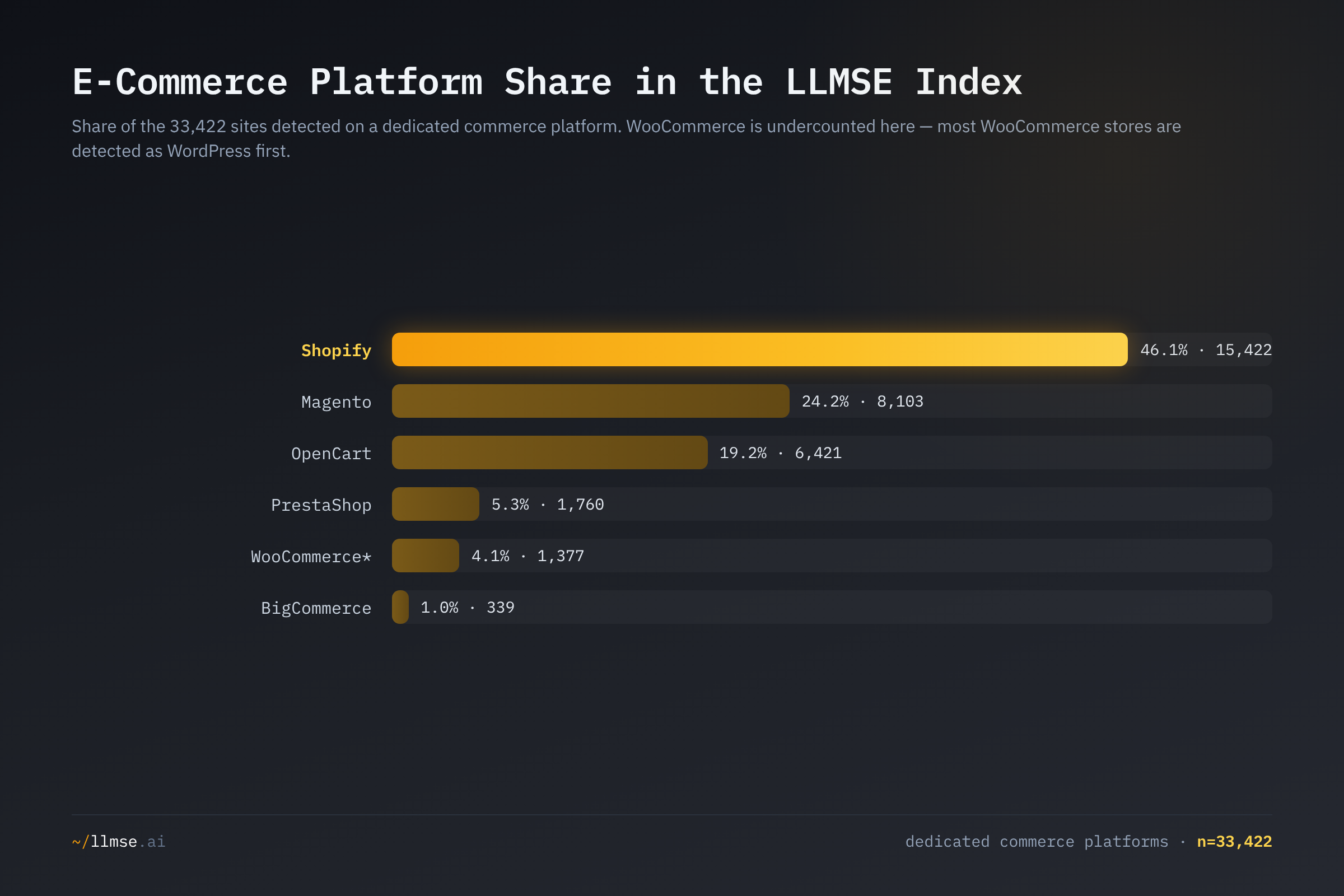
* WooCommerce is a WordPress plugin; the 1,377 sites here are those where WooCommerce-specific storefront markup is the primary detection signal — the great majority of WooCommerce stores are detected as WordPress first and counted there. BigCommerce is graded on only ~338 sites, so its rates are indicative rather than precise.
Shopify's 46.1% in-index share is a detection artifact, not a market-share claim. Independent trackers put Shopify's global e-commerce share in the 23-28% range and WooCommerce's at 20-33% depending on methodology: ECDB reports Shopify at 23.4%, Magento 8.4%, WooCommerce 4.9%, while BuiltWith data (via Mobiloud) puts Shopify at 26.2% of all e-commerce sites and WooCommerce at 20.1%, with Store Leads tracking WooCommerce as the single largest engine at 33.4% (4.53M of 13.6M stores). The reason LLMSE's distribution looks so different is the WooCommerce detection caveat above — WooCommerce's true volume is absorbed into the WordPress count — and the fact that Magento and OpenCart leave unambiguous, easy-to-detect storefront signatures. Read the table as "which engine fingerprint is dominant," not "which platform is biggest."
Coverage differs by dimension, because not every URL carries every grade. The commerce set is graded as follows, against the web-wide pass rate for each dimension:
| Dimension | Commerce sites graded | Commerce-set definition of "pass" | Web-average pass rate |
|---|---|---|---|
| SEO | 32,875 | A+B+C | 1.9% |
| AEO (AI answers) | 32,804 | A+B+C | 1.5% |
| EEAT (trust) | 32,877 | A+B+C | 45.4% |
| WCAG (accessibility) | 32,819 | A+B+C | 43.8% |
| Readability | 32,821 | A+B (Flesch ~50+) | 32.8% |
| Privacy | 32,781 | A+B+C | 37.0% |
| GARM (brand safety) | 19,025 | A only | 90.2% |
Two structural facts shape everything below. First, e-commerce is the web's trust-heavy, brand-safe corner: every one of these platforms clears the EEAT web average, and all six are 90%+ brand-safe on GARM — product pages, business identity, and commercial copy are exactly what trust and brand-safety analyzers reward. Second, e-commerce is a discovery desert: only one platform beats the 1.9% web SEO average, and AI-answer optimization is near zero almost everywhere. Those two facts frame the trade-offs the rest of this index documents.
Methodology
This post makes quantitative comparisons across platforms, so the definitions and limits matter.
- Grades and "pass." Each site is graded A-F by a dedicated automated analyzer (there is no E grade). "Pass" means A+B+C for SEO, AEO, EEAT, WCAG, and Privacy; A+B for Readability (a Flesch Reading Ease score of roughly 50+, ≈ 8th-grade level or below); and A only ("brand-safe") for GARM. SEO grades technical fundamentals (canonicalization, metadata, structured markup, crawlability); AEO grades answer-extractability and AI-citation signals; EEAT grades experience/expertise/authoritativeness/trust signals; WCAG covers automated accessibility checks; Readability uses Flesch scoring; Privacy grades consent gating, policy presence, and tracker behavior; GARM grades brand-suitability per the Global Alliance for Responsible Media framework.
- Platform detection is by HTML signature — storefront-specific CSS classes, JavaScript references, CDN patterns, and meta tags observed during classification. It identifies the dominant engine; sites layering multiple technologies are attributed to their primary storefront signal.
- Classification basis. Each grade is an independent automated analyzer. Where a check is heuristic — notably WCAG, which runs on static HTML and covers roughly the 30-40% of WCAG 2.1 Level A criteria that can be machine-tested — manual auditing is still required for full conformance, so treat WCAG rates as a floor, not a verdict.
- Cross-references are computed as set intersections (Redis
ZINTERCARD) between anapp-{Platform}index and each grade index (seo-A,eeat-C, and so on). All counts are aggregate; no individual store is identified. - Known limits. Pass rates are over graded populations, which are smaller than raw platform size. BigCommerce (n≈338 graded) and, to a lesser extent, WooCommerce (n≈1,350) and PrestaShop (n≈1,700) are small samples — flagged throughout. The Readability grade is calibrated for English, so it understates readability for platforms with heavy non-English content (notably PrestaShop and OpenCart). Russian-language sites are excluded from all aggregates. The index is a live snapshot, not a time series, so this post makes no growth or trend claims.
- Why these numbers differ from the original. When first published in March 2026 this index covered 24,218 dedicated-commerce sites and four dimensions; it now covers 33,422 across seven, and the graded population behind every cell has roughly doubled. Two consequences follow. First, absolute pass rates fell as coverage broadened past the earliest, most-visible stores — the web EEAT average moved from 48.3% to 45.4% and WCAG from 52.7% to 43.8%. Second, rankings built on a few hundred early grades reshuffled: OpenCart's headline 97.1% EEAT (the original's leader) is now 88.6% and second to Shopify; BigCommerce's 4.8% SEO lead collapsed to 1.5% as its sample grew; and Wix's "88% WCAG failure" eased to ~64%. The original's per-platform demographic, language, category, and server breakdowns were dropped — they were thinly graded and orthogonal to a quality index.
The Scorecard
Pass rates by platform across all six graded quality dimensions, ordered by indexed site count. The best cell in each column is bolded.
| Platform | Sites | SEO | AEO | EEAT | WCAG | Read. | Privacy |
|---|---|---|---|---|---|---|---|
| Shopify | 15,422 | 1.3% | 6.0% | 91.8% | 26.4% | 52.5% | 76.9% |
| Magento | 8,103 | 0.8% | 1.2% | 67.0% | 41.2% | 51.1% | 52.0% |
| OpenCart | 6,421 | 0.2% | 0.5% | 88.6% | 5.9% | 72.3% | 32.7% |
| PrestaShop | 1,760 | 0.9% | 0.6% | 65.7% | 15.2% | 28.7% | 38.2% |
| WooCommerce | 1,377 | 3.8% | 2.7% | 61.7% | 37.4% | 34.4% | 35.1% |
| BigCommerce* | 339 | 1.5% | 2.7% | 76.6% | 28.1% | 52.1% | 63.6% |
| Web average | 3.4M | 1.9% | 1.5% | 45.4% | 43.8% | 32.8% | 37.0% |
* Small graded sample (n≈338); interpret BigCommerce rates as indicative.
The Superlatives
| Dimension | Best platform | Rate | Worst platform | Rate |
|---|---|---|---|---|
| SEO | WooCommerce | 3.8% | OpenCart | 0.2% |
| AEO | Shopify | 6.0% | OpenCart | 0.5% |
| EEAT | Shopify | 91.8% | WooCommerce | 61.7% |
| WCAG | Magento | 41.2% | OpenCart | 5.9% |
| Readability | OpenCart | 72.3% | PrestaShop | 28.7% |
| Privacy | Shopify | 76.9% | OpenCart | 32.7% |
Shopify leads three of six dimensions; no other platform leads more than one. Shopify owns trust, privacy, and AI-answers; WooCommerce takes SEO; Magento takes accessibility; OpenCart takes readability. The same platform, OpenCart, also loses four of six — the widest spread on the board, and the clearest illustration that a strength on one axis predicts nothing about the others. The rest of this index is the story of those gaps.
Discovery: WooCommerce Leads SEO, Shopify Owns AI Answers
Only one commerce platform beats the web's 1.9% SEO pass rate, and it is WooCommerce at 3.8% — double the web average and triple Shopify's 1.3%. WooCommerce's WordPress heritage is the plausible explanation: it inherits the most mature SEO plugin ecosystem on the web (Yoast, Rank Math, All in One SEO), and the merchants who go to the trouble of running a self-hosted store on it skew toward operators who also configure canonical URLs, schema, and sitemaps.
| Platform | Graded | A+B+C (pass) | Pass rate | F-rate |
|---|---|---|---|---|
| WooCommerce | 1,352 | 52 | 3.8% | 89.5% |
| BigCommerce* | 338 | 5 | 1.5% | 96.4% |
| Shopify | 15,239 | 192 | 1.3% | 96.4% |
| PrestaShop | 1,705 | 16 | 0.9% | 97.3% |
| Magento | 7,870 | 64 | 0.8% | 97.5% |
| OpenCart | 6,371 | 11 | 0.2% | 99.2% |
| Web average | 3.4M | — | 1.9% | — |
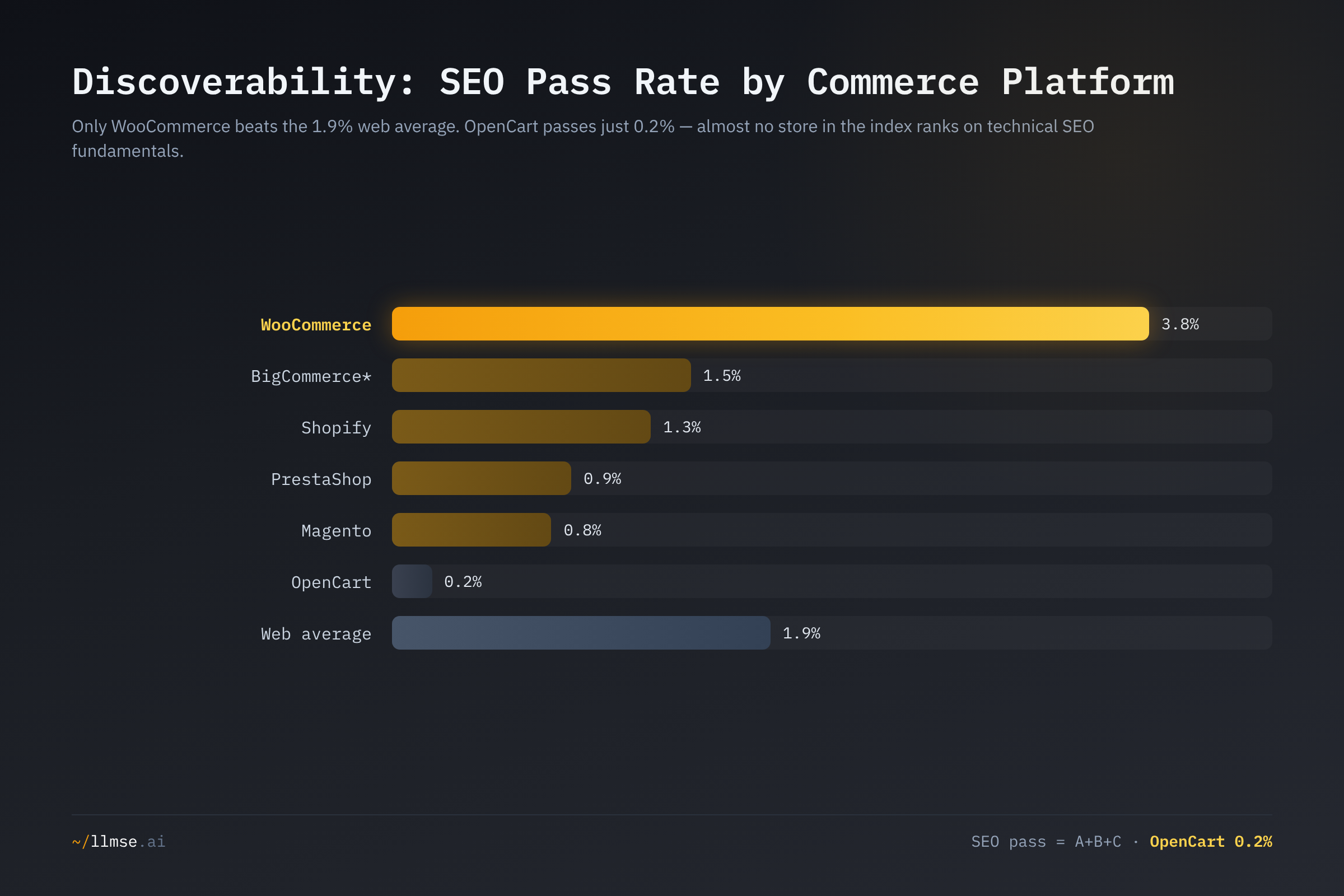
OpenCart passes technical SEO on just 1 store in 500 (0.2%) — a 99.2% F-rate. That finding survives from the original index intact and at scale: OpenCart stores ship with thin templated metadata, weak canonicalization, and little structured markup out of the box, and its merchant base (concentrated in price-competitive, catalog-heavy verticals) rarely invests in remediating it. BigCommerce's 1.5% is the headline reversal here — it led the original index at 4.8% on a sample of 83 graded sites, and as that sample grew past 300 the rate collapsed to the pack. It is a textbook small-sample correction, and a caution against reading platform "SEO defaults" off a few dozen flagship stores.
The newer discovery axis tells a different story. Shopify leads AI-answer optimization at 6.0% — four times the web average and the only commerce platform meaningfully above it (WooCommerce and BigCommerce tie at 2.7%; Magento, PrestaShop, and OpenCart sit at or below 1.2%). AEO rewards extractable, well-structured content — the product schema, FAQ markup, and clean answer-shaped copy that Google's AI features and structured-data guidance increasingly favor — and Shopify's templates and app ecosystem generate exactly those signals by default. As zero-click and AI-answer surfaces eat into classic search traffic, this is the discovery gap that will matter most, and it is the one place a managed platform's defaults visibly pay off. (The cross-sector view of this gap is in The AI Citation Readiness Gap.)
Trust: Shopify's EEAT Surge
Shopify now posts the highest EEAT pass rate of any commerce platform at 91.8% — and 46.5% of its graded stores earn an outright A. This is the index's biggest leaderboard change. In the original, OpenCart led EEAT at 97.1%; today Shopify edges ahead, and the quality of the two leads could not be more different.
| Platform | Graded | A-rate | A+B+C pass rate |
|---|---|---|---|
| Shopify | 15,259 | 46.5% | 91.8% |
| OpenCart | 6,366 | 9.2% | 88.6% |
| BigCommerce* | 338 | 11.2% | 76.6% |
| Magento | 7,849 | 24.3% | 67.0% |
| PrestaShop | 1,709 | 2.6% | 65.7% |
| WooCommerce | 1,356 | 8.6% | 61.7% |
| Web average | 3.4M | — | 45.4% |
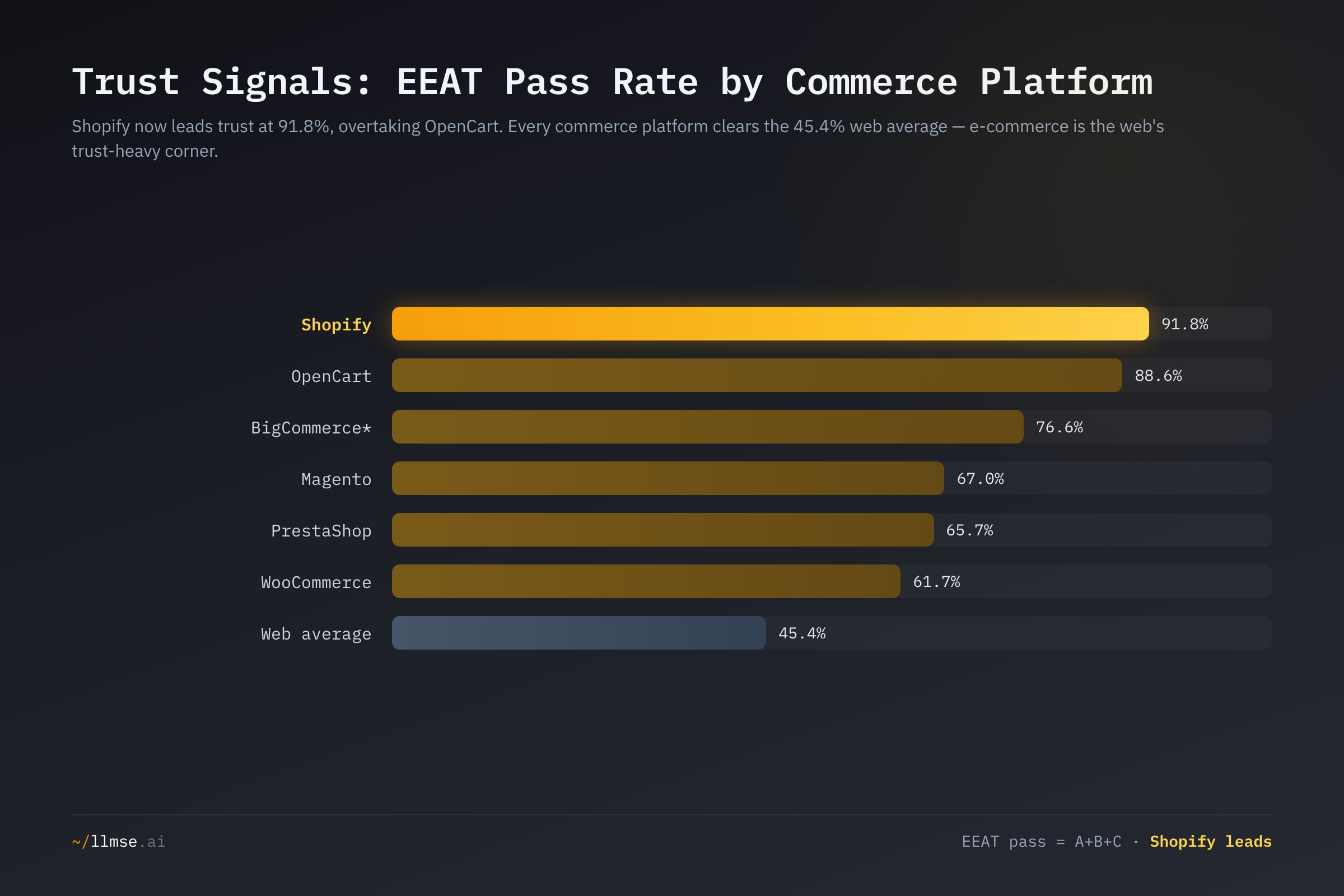
OpenCart's 88.6% is wide but shallow; Shopify's 91.8% is wide and deep. Of OpenCart's passing sites, 57.6% sit at C-grade and only 9.2% reach A — many stores clear the minimum bar, almost none excel. Shopify inverts that: nearly half its stores earn an A. The mechanism is plausible and consistent with Google's guidance on demonstrating experience and trust — Shopify's theme ecosystem ships structured about pages, contact and policy pages, review and trust-badge integrations, and consistent business-identity markup, so the signals EEAT measures are generated by default rather than by merchant effort. Every commerce platform clears the web's 45.4% EEAT average, which is the structural point: commerce is the trust-heavy corner of the web. But within it, Shopify has pulled clearly ahead.
Accessibility: Magento Leads a Field That Trails the Web
Accessibility is where commerce platforms look worst, and it is the dimension with the steepest legal exposure. With the European Accessibility Act in force since June 2025, the U.S. DOJ web accessibility rule issued, and digital-accessibility lawsuits running at record volume, an inaccessible storefront is now a compliance liability, not just a UX shortfall.
| Platform | Graded | A+B+C pass rate | F-rate |
|---|---|---|---|
| Magento | 7,814 | 41.2% | 48.6% |
| WooCommerce | 1,350 | 37.4% | 47.6% |
| BigCommerce* | 338 | 28.1% | 62.4% |
| Shopify | 15,250 | 26.4% | 61.8% |
| PrestaShop | 1,706 | 15.2% | 74.2% |
| OpenCart | 6,361 | 5.9% | 86.1% |
| Web average | 3.4M | 43.8% | — |
No dedicated commerce platform clears the 43.8% web accessibility average — Magento, the leader at 41.2%, comes closest but falls just short. This is a genuine refresh from the original, where Magento (55.1%) was reported as the one commerce platform above the then-higher web average (52.7%); as coverage broadened, both numbers fell and Magento landed just under the new bar. The standing of the field, though, is unchanged: commerce platforms build some of the least accessible pages on the web.
OpenCart fails accessibility more completely than anything else here — 86.1% of its stores grade F, with a 5.9% pass rate. Image-dense catalogs, custom add-to-cart widgets, unlabeled form controls, and interactive filters are precisely the patterns that fail automated checks, and OpenCart's lean default templates ship few of the semantic and ARIA scaffolds that clear them. Shopify's 26.4% is notable for a managed platform — its visually rich, JavaScript-heavy themes optimize for conversion over keyboard and screen-reader navigation. The website builder Squarespace, by contrast, passes WCAG at 53.3% — above the web average and well clear of every commerce engine — a reminder that opinionated, semantic-by-default templates do measurably better here. For context on the regulatory clock, see European Accessibility Act Readiness and WCAG Compliance by Industry.
Readability: OpenCart's Spec-Sheet Advantage
The platform that loses SEO and accessibility wins the readability dimension outright. OpenCart leads readability at 72.3%, with 62.8% of its stores earning an A — the highest A-rate of any platform measured.
| Platform | Graded | A-rate | A+B pass rate |
|---|---|---|---|
| OpenCart | 6,361 | 62.8% | 72.3% |
| Shopify | 15,250 | 29.2% | 52.5% |
| BigCommerce* | 338 | 26.3% | 52.1% |
| Magento | 7,816 | 35.6% | 51.1% |
| WooCommerce | 1,350 | 11.2% | 34.4% |
| PrestaShop | 1,706 | 12.6% | 28.7% |
| Web average | 3.4M | 19.7% | 32.8% |
Five of six commerce platforms beat the web's 32.8% readability pass rate — only PrestaShop falls below it — and OpenCart more than doubles it. The plausible explanation is content shape, not editorial skill: OpenCart, Magento, and Shopify catalogs lean on short product titles, bulleted specifications, and price-and-feature copy that score well on Flesch Reading Ease, where dense editorial prose does not. The English-calibration caveat cuts the other way for OpenCart and PrestaShop, both of which carry heavy non-English content the Flesch metric handles imperfectly — so OpenCart's lead is real but should be read as "short, structured copy," not "the clearest writing on the web." WooCommerce (34.4%, only just above the web average) and PrestaShop (28.7%, below it) are the commerce-set laggards: WooCommerce inherits WordPress's blog-length, marketing-heavy page patterns, which raise reading complexity above a tight product catalog.
Privacy: Managed Platforms Lead, OpenCart Lags
Privacy is one of the dimensions added since the original. It grades consent gating, the presence of privacy and cookie policies, and tracker discipline — exactly the obligations that GDPR's consent rules and CCPA place on any store handling customer accounts and payments.
| Platform | Graded | A+B+C pass rate |
|---|---|---|
| Shopify | 15,242 | 76.9% |
| BigCommerce* | 338 | 63.6% |
| Magento | 7,796 | 52.0% |
| PrestaShop | 1,706 | 38.2% |
| WooCommerce | 1,347 | 35.1% |
| OpenCart | 6,352 | 32.7% |
| Web average | 3.4M | 37.0% |
Shopify leads privacy at 76.9% and BigCommerce follows at 63.6% — the two most managed platforms cluster at the top, while the most self-hosted, OpenCart, trails at 32.7%, below the web average. This is consistent with how the platforms are operated rather than any inherent capability: Shopify and BigCommerce centralize consent banners, policy pages, and tracker management as platform-level defaults their merchants inherit automatically, whereas self-hosted OpenCart and WooCommerce stores must bolt those on themselves, and many do not. That is a plausible mechanism, not a proven cause. The implication for self-hosted merchants is concrete — the privacy obligations apply regardless of platform, and the platforms that leave it to the merchant are the ones whose stores most often fall short. The cross-sector picture is in The Privacy Compliance Report.
The Paradoxes
The most revealing patterns are the gaps between dimensions inside a single platform. Two stand out.
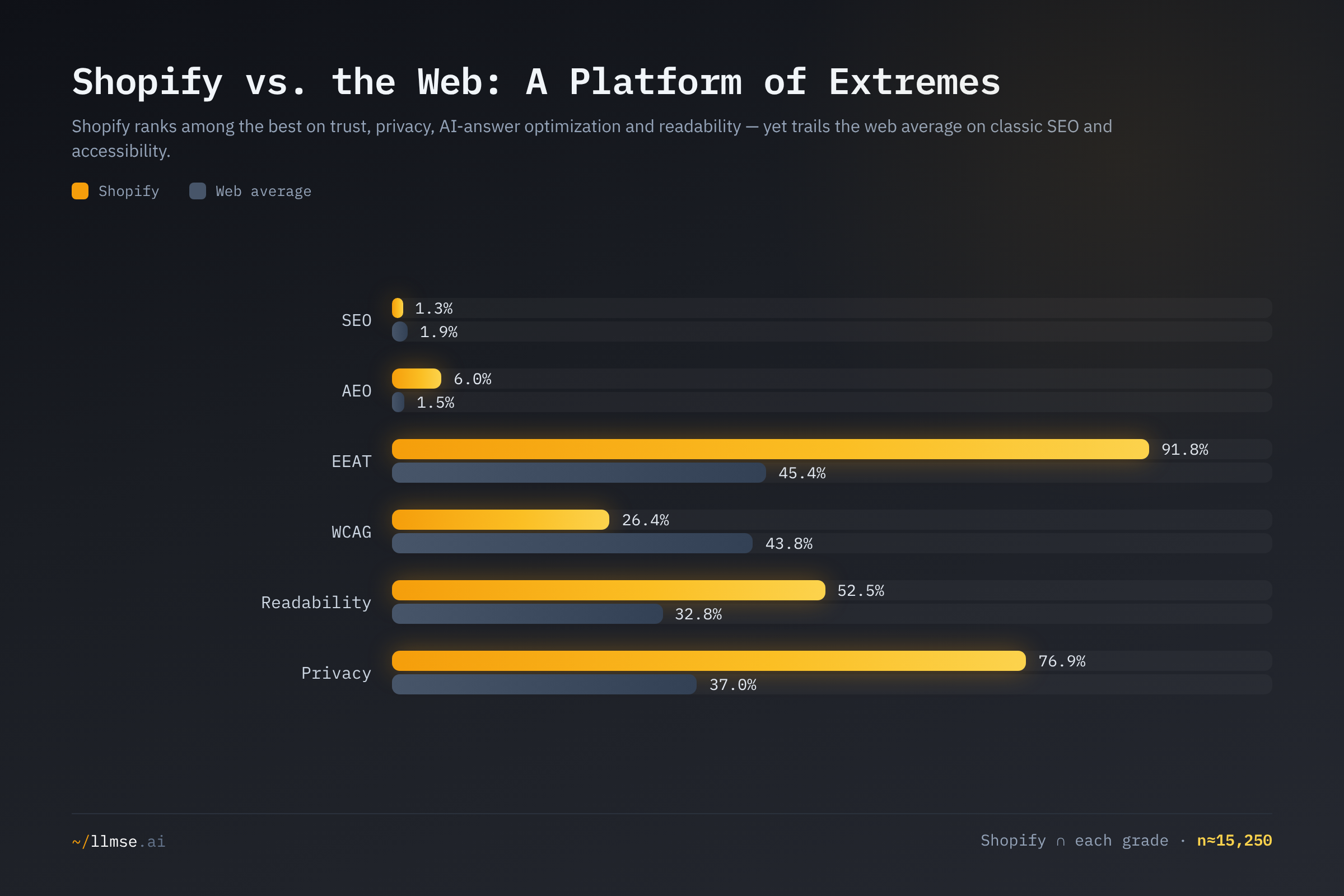
Shopify: the trusted, private, AI-ready store that classic search can't find and assistive tech can't navigate. Shopify is at or near the top of four dimensions — EEAT (91.8%), privacy (76.9%), AEO (6.0%), readability (52.5%) — yet sits below the web average on both SEO (1.3% vs 1.9%) and WCAG (26.4% vs 43.8%). The platform has perfected the signals that build trust and convert an intent-driven shopper, and the structured content that answer engines reward, while neglecting the technical SEO fundamentals that win classic rankings and the semantic markup that serves a screen-reader user. The 90-point gap between its best dimension (EEAT) and its worst (SEO) is the widest single-platform spread on the board.
OpenCart: the most readable storefront on the web, and almost the least findable, accessible, or AI-ready. OpenCart posts the best readability (72.3%) and the second-best EEAT (88.6%), then collapses on SEO (0.2%, worst), WCAG (5.9%, worst), AEO (0.5%, worst), and privacy (32.7%, worst). It is the clearest single-platform proof of the index's thesis: a store can be clearly written and broadly trusted while being effectively invisible to search, unusable with assistive technology, and indifferent to data-protection signals.
These gaps are the core finding: quality is multi-dimensional, and the dimensions trade off. No platform in the data is uniformly good — and the platform decision is therefore a decision about which failure mode you are willing to accept and remediate. This index differs from the broader CMS Quality Gap analysis precisely here: among general-purpose CMSs, EEAT is where platform choice swings most; among dedicated commerce engines, trust is uniformly high and the real divergence is on discovery, accessibility, and privacy.
What's at Stake
- Discovery is a near-universal failure, and AI answers will inherit it. Five of six commerce platforms trail the 1.9% web SEO average, and AEO tops out at Shopify's 6.0%. As AI answer engines replace blue links for product research, stores that have not built extractable, schema-rich content will lose visibility they cannot easily buy back — and the platforms whose defaults already generate those signals (Shopify) will compound their advantage.
- Trust and accessibility are decoupled. Every commerce platform clears the web EEAT average; none clears the web accessibility average. The sector that most needs to serve every shopper — including the over one billion people living with disability — systematically underbuilds for assistive technology, exactly as the EAA and the DOJ web rule make that gap a legal liability.
- Privacy maps to who operates the store, not to capability. Managed platforms (Shopify, BigCommerce) post the highest privacy rates because they centralize consent and policy defaults; self-hosted OpenCart and WooCommerce stores, which inherit none of that, sit below the web average. The obligation is identical; the latent compliance gap sits with self-hosted merchants who never added what their platform left out.
- Small samples mislead, and managed defaults are oversold. BigCommerce's SEO "lead" in the original (4.8%) evaporated to 1.5% once its sample tripled, and Shopify — the most-defaulted platform — still trails the web on SEO. Platform marketing that promises good outcomes "out of the box" is, on the aggregate evidence, only true for the specific dimensions a platform's templates actually encode (trust and AEO for Shopify), not for quality writ large.
What Would Help
- Merchants: audit the dimension your platform is blind to, not the one it leads. The index's lesson is that platform strengths are narrow. A Shopify store is probably failing SEO and accessibility; an OpenCart store is probably failing nearly everything except readability and trust. Run a full multi-dimension check at llmse.ai/classify rather than trusting that a strong platform reputation covers you.
- Commerce and front-end teams: fix accessibility before it becomes litigation. No commerce platform clears the web WCAG average, and OpenCart (5.9%) and PrestaShop (15.2%) are acute. Semantic structure, labeled form controls, alt text, and keyboard-navigable cart and filter widgets are the cheapest wins relative to the legal exposure now attached to them.
- Self-hosted merchants (OpenCart, WooCommerce, PrestaShop): add the privacy and SEO layer your platform doesn't. Managed platforms inherit consent banners, policy pages, and canonical/sitemap defaults; you do not. A consent-management install and an SEO plugin configured properly close most of the gap to Shopify on privacy and to WooCommerce on SEO.
- Platform vendors: ship the missing defaults. Shopify proves trust and AEO can be encoded into templates; the same approach would lift the dimensions every commerce platform fails. Accessible component libraries, default structured-SEO markup, and built-in consent management would move the aggregate more than any single merchant's effort.
- AI platforms and shopping agents: weight trust and provenance, not just extractability. Because commerce AEO is uniformly low while trust is uniformly high, naive retrieval will over-surface whatever store is best formatted rather than best operated. Prefer stores with strong EEAT and privacy signals when answering product queries, not merely the ones with the cleanest schema.
This analysis was conducted using LLMSE, which has classified over 3.4 million websites across SEO, EEAT, AEO, WCAG accessibility, readability, GARM brand safety, and privacy dimensions. Commerce-platform figures reflect the 33,422 sites running a dedicated e-commerce platform in the index, with per-dimension pass rates computed over the populations graded on each dimension, as of June 2026. To analyze your own store across every dimension in this index, visit llmse.ai/classify.