The CMS Quality Gap: Twelve Platforms Graded on SEO, AEO, Trust, Accessibility, Readability, and Privacy
Update — 2026-06-29: This comparison has been refreshed against LLMSE's current index of 3.4 million classified URLs (up from ~1.4M at first publication) and expanded from four quality dimensions to six, adding AEO (AI-answer optimization) and Privacy. The original ranked platforms on tiny graded subsets — Shopify's trust score came from 305 sites, its accessibility from 52 — and almost every leaderboard flipped once the full populations were graded: Shopify now leads trust (91.8%, not Webflow), readability (52.5%, not Medium), and the two new axes; Jekyll leads accessibility (66.1%, not Squarespace); Astro still tops SEO. Next.js is no longer the trust laggard. The thesis the original argued — your CMS predicts your quality — survives, and is sharper: platform choice predicts the shape of a site's quality across dimensions, not whether it ranks.
Pick a CMS and you have, without realizing it, picked a quality profile. Not because the platform writes your content, but because its defaults, constraints, and tooling push every site built on it toward the same strengths and the same blind spots. A Shopify store and a Jekyll blog are not merely different to build — they fail in opposite directions, and the aggregate data makes the divergence unmistakable.
The conventional advice treats CMS choice as a question of features, price, and developer taste, with quality framed as something you add on top through effort. The implication is that any platform can produce any outcome if you try hard enough. That is half true. Effort matters enormously within a platform — but the platform sets the starting line, and across hundreds of thousands of sites the starting line dominates. The question this post answers is the one feature checklists cannot: when real sites are built on each platform at scale, which dimensions does that platform reliably get right, and which does it reliably get wrong?
We graded twelve CMS, builder, publishing, and framework platforms — WordPress, Medium, Drupal, Joomla, Squarespace, Astro, Next.js, Jekyll, Shopify, Webflow, Wix, and Ghost — against six quality dimensions: technical SEO, AEO (optimization for AI answer engines), EEAT (trust signals), WCAG accessibility, readability, and privacy. Every grade comes from LLMSE's automated pipeline applied uniformly across an index of 3.4 million URLs, and — unlike the first version of this post — nearly the entire population of each platform is now graded on every dimension.
No platform wins more than four of six dimensions, and the one that comes closest, Shopify, is dead last on accessibility. Shopify tops trust, readability, AEO, and privacy; static generators and JS frameworks (Astro, Jekyll, Next.js) own SEO and accessibility; the hosted builders earn trust but neglect findability and assistive technology; and WordPress — the platform behind 1.06 million sites in our index — beats the all-web baseline on every dimension while leading none. SEO, meanwhile, is a near-universal failure: no well-sampled platform clears 5%.
The Data
The twelve platforms below span every major way a site gets built: extensible open-source CMSes (WordPress, Drupal, Joomla), hosted website builders (Squarespace, Wix, Webflow), a hosted commerce platform (Shopify), publishing platforms (Medium, Ghost), and the developer-oriented static generators and frameworks (Astro, Jekyll, Next.js). Detection is by HTML fingerprinting — generator meta tags, script sources, CSS class patterns, and platform-specific signatures.
| Platform | Type | Sites in index |
|---|---|---|
| WordPress | Open-source CMS | 1,060,974 |
| Medium | Publishing platform | 292,123 |
| Drupal | Open-source CMS | 35,626 |
| Joomla | Open-source CMS | 28,238 |
| Squarespace | Hosted builder | 26,544 |
| Astro | Static-site framework | 23,797 |
| Next.js | React framework | 21,305 |
| Jekyll | Static-site generator | 17,666 |
| Shopify | Hosted commerce | 15,422 |
| Webflow | Hosted builder | 13,488 |
| Wix | Hosted builder | 3,051 |
| Ghost | Publishing platform | 1,243 |
Pass rates throughout are computed over the population actually graded on each dimension. For ten of these twelve platforms that population is large — between ~13,000 and ~1.05 million graded sites per dimension, typically 95-99% of the platform's full index. Wix (~3,000 graded per dimension) and Ghost (~1,200) are smaller and flagged accordingly. The web-wide baselines each platform is measured against:
| Dimension | URLs graded (web-wide) | Web-average pass rate |
|---|---|---|
| SEO | 3,362,581 | 1.9% |
| AEO (AI answers) | 3,337,567 | 1.5% |
| EEAT (trust) | 3,358,451 | 45.4% |
| WCAG (accessibility) | 3,341,490 | 43.8% |
| Readability | 3,341,641 | 32.8% |
| Privacy | 3,335,755 | 37.0% |
For independent corroboration of platform scale, W3Techs' June 2026 CMS survey puts WordPress at 41.5% of all websites and 59.2% of the CMS market, with Shopify (5.2% / 7.5%), Wix (4.3% / 6.1%), Squarespace (2.5% / 3.5%), Joomla (1.2% / 1.7%), Webflow (0.9% / 1.2%), and Drupal (0.7% / 1.0%) trailing far behind. LLMSE's index is a crawl sample, not a census, so our relative ordering tracks W3Techs but the absolute counts will differ.
Methodology
This post makes quantitative cross-platform comparisons, so the definitions and limits matter.
- Grades and "pass." Each site is graded A-F by a dedicated automated analyzer (there is no E grade). "Pass" means A+B+C for SEO, AEO, EEAT, WCAG, and Privacy, and A+B for Readability (a Flesch Reading Ease score of roughly 50+, ≈ 8th-grade level or below). SEO grades technical fundamentals; AEO grades answer-extractability and AI-citation signals (direct answers, schema, comparison tables, statistics); EEAT grades experience/expertise/authoritativeness/trust signals; WCAG covers automated accessibility checks (~30-40% of WCAG 2.1 Level A — full conformance requires manual testing); Privacy grades consent gating, policy presence, and tracker discipline.
- Detection basis. Platform membership is by HTML-signature fingerprinting; each grade is an independent automated analyzer run against the HTML retrieved during classification. Headless and heavily customized deployments may evade detection, so each platform's set skews toward sites that expose recognizable signatures.
- Cross-references are computed as set intersections (Redis
ZINTERCARD) between a platform index (app-{Platform}) and each grade index. All counts are aggregate; no individual site is identified. - Known limits. Pass rates are over graded populations. The Readability grade uses Flesch scoring, which is calibrated for English, so it understates readability for platforms with heavy non-English content — treat cross-platform readability as indicative, not exact. Counts are a live snapshot and drift as classification continues. Russian-language sites are excluded from all breakdowns. Ghost's ~1,200-site sample is too small to anchor any "best/worst" call and is flagged wherever it appears.
- Why these numbers differ from the original. The first version of this post graded each platform on whatever subset had been analyzed at the time — and for several platforms that subset was tiny: Shopify's EEAT score came from 305 sites, its accessibility from 52, its readability from 57; Squarespace's accessibility from 438; Webflow's from 105. Those samples skewed toward early, higher-quality crawls, which is why Shopify looked mid-pack on trust (58.7%) and Squarespace looked like the accessibility champion (74.0%). The index has since grown from ~1.4M to ~3.4M URLs and now grades nearly the entire population of each platform (Shopify EEAT: 15,259 sites; Squarespace WCAG: 26,291). The broader, fuller samples reshuffled almost every leaderboard and pulled the absolute web baselines down a few points (web EEAT 45.4%, WCAG 43.8%, readability 32.8%). The thesis held; the specific leaders did not.
The Scorecard
Pass rates by platform, ordered by indexed site count. The standout (best) well-sampled cell in each column is bolded.
| Platform | Sites | SEO | AEO | EEAT | WCAG | Read. | Privacy |
|---|---|---|---|---|---|---|---|
| WordPress | 1,060,974 | 2.8% | 2.3% | 59.8% | 45.1% | 33.0% | 47.2% |
| Medium | 292,123 | 2.4% | 2.0% | 68.7% | 36.6% | 39.0% | 51.4% |
| Drupal | 35,626 | 2.6% | 2.4% | 65.6% | 49.2% | 19.6% | 56.7% |
| Joomla | 28,238 | 0.4% | 0.4% | 62.4% | 35.4% | 37.0% | 38.1% |
| Squarespace | 26,544 | 1.9% | 1.0% | 33.8% | 53.3% | 41.8% | 20.8% |
| Astro | 23,797 | 4.9% | 1.9% | 61.4% | 37.0% | 28.4% | 30.7% |
| Next.js | 21,305 | 4.3% | 1.3% | 47.8% | 54.3% | 26.8% | 31.8% |
| Jekyll | 17,666 | 4.8% | 1.0% | 57.6% | 66.1% | 38.0% | 4.4% |
| Shopify | 15,422 | 1.3% | 6.0% | 91.8% | 26.4% | 52.5% | 76.9% |
| Webflow | 13,488 | 1.4% | 2.5% | 86.6% | 31.3% | 27.4% | 69.2% |
| Wix | 3,051 | 1.1% | 0.8% | 86.9% | 25.2% | 17.5% | 60.1% |
| Ghost* | 1,243 | 9.9% | 1.7% | 33.6% | 74.5% | 45.9% | 23.0% |
| Web average | 3.4M | 1.9% | 1.5% | 45.4% | 43.8% | 32.8% | 37.0% |
*Ghost's graded sample is ~1,200 sites per dimension; its SEO (9.9%) and accessibility (74.5%) lead the table but rest on too few sites to call a winner. It is excluded from the superlatives below.
The Superlatives
| Dimension | Best platform | Rate | Worst platform | Rate |
|---|---|---|---|---|
| SEO | Astro | 4.9% | Joomla | 0.4% |
| AEO | Shopify | 6.0% | Joomla | 0.4% |
| EEAT | Shopify | 91.8% | Squarespace | 33.8% |
| WCAG | Jekyll | 66.1% | Wix | 25.2% |
| Readability | Shopify | 52.5% | Wix | 17.5% |
| Privacy | Shopify | 76.9% | Jekyll | 4.4% |
One name dominates the top of the board: Shopify wins four of six dimensions — AEO, trust, readability, and privacy — and finishes near the bottom of a fifth, accessibility (26.4%). The discovery axis it cedes to the developer platforms: Astro and Jekyll lead SEO, while Joomla collapses on both SEO and AEO at 0.4%. Wix anchors the bottom on the two things it cannot enforce — accessibility and readability — even as it posts one of the highest trust scores. The rest of this report is the story of why each platform leads where it leads and fails where it fails.
Discovery: Static Generators Lead, Joomla Collapses
Among well-sampled platforms, Astro (4.9%), Jekyll (4.8%), and Next.js (4.3%) top technical SEO — roughly 2.5x the 1.9% web average and the only platforms above 4%. The pattern is consistent across the developer-tooling tier: static generators and frameworks emit clean, predictable, server-rendered HTML with sensible defaults — valid markup, canonical tags, fast first paint — and no plugin sediment or page-builder bloat to accumulate deductions. Joomla is worst at 0.4%, a fifth of the web rate, with 98% of its graded sites scoring F; its aging default templates and SEO-unfriendly URL handling leave most installs failing the fundamentals.
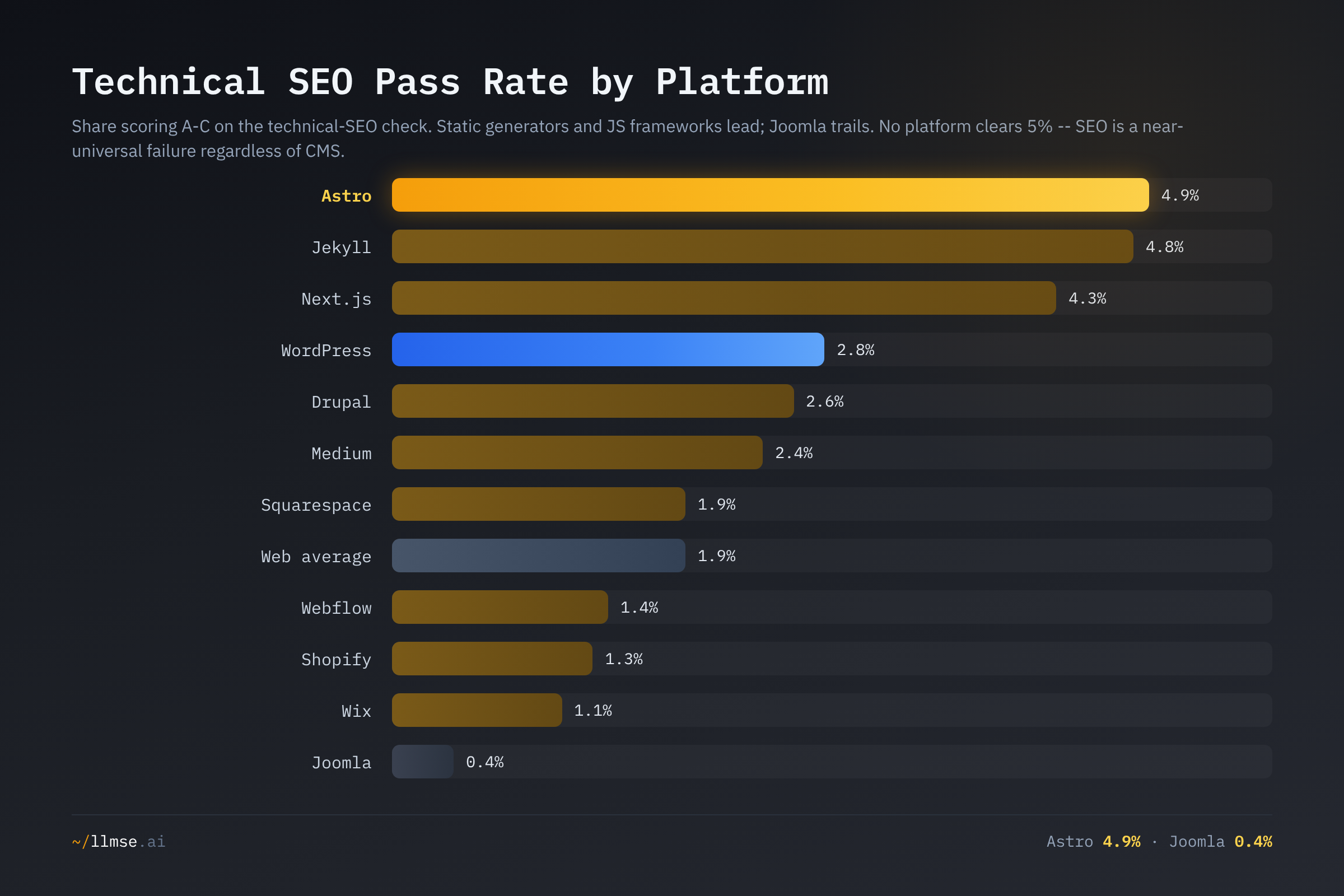
The headline, though, is the compression of the whole field: the gap between the best well-sampled platform and the web average is just three points. Your CMS moves your SEO odds by a few percentage points; it does not fix them. This is worth stating because automated tooling tells a rosier story. The 2025 Web Almanac CMS chapter finds median Lighthouse SEO scores of 92-100 across every major CMS — Webflow and Wix at a perfect 100, WordPress and Joomla at 92 — and concludes "basic SEO best practices are now widely baked into modern CMS platforms." Both readings are correct because they measure different things. Lighthouse runs a handful of technical audits — title tag, meta description, crawlable links, viewport — that modern platforms pass by default. LLMSE's SEO grade is a far stricter composite of on-page signals, and on that bar the median site on every platform still fails. Platform defaults clear the low bar; they do not clear the high one.
AEO inverts the SEO leaderboard. Shopify tops AI-answer optimization at 6.0% — four times the web average and the highest of any platform — while the static generators that win SEO sit mid-pack (Astro 1.9%, Jekyll 1.0%). The mechanism is structural: AEO rewards product schema, comparison tables, specs, FAQs, and extractable direct answers, and Shopify's commerce templates emit exactly that markup by default. The signals that get a page lifted into an AI answer are not the same as the signals that pass a technical-SEO audit, and a platform can be built for one without the other. The dependence on structured, citable content is the same dynamic a Princeton-led KDD 2024 study measured directly — adding citations, quotations, and statistics lifted a source's visibility in generative-engine answers by up to 40%.
Trust: Shopify Overtakes the Builders
EEAT is the dimension where platform choice creates the widest, most defensible spread — and where the original post's leaderboard flipped hardest. Shopify now leads trust at 91.8%, with Wix (86.9%) and Webflow (86.6%) close behind. The original crowned Webflow at 87.4%; Shopify looked like a mid-tier 58.7% then — but that figure rested on 305 graded sites. Graded across its full ~15,000-site population, Shopify is the runaway leader.
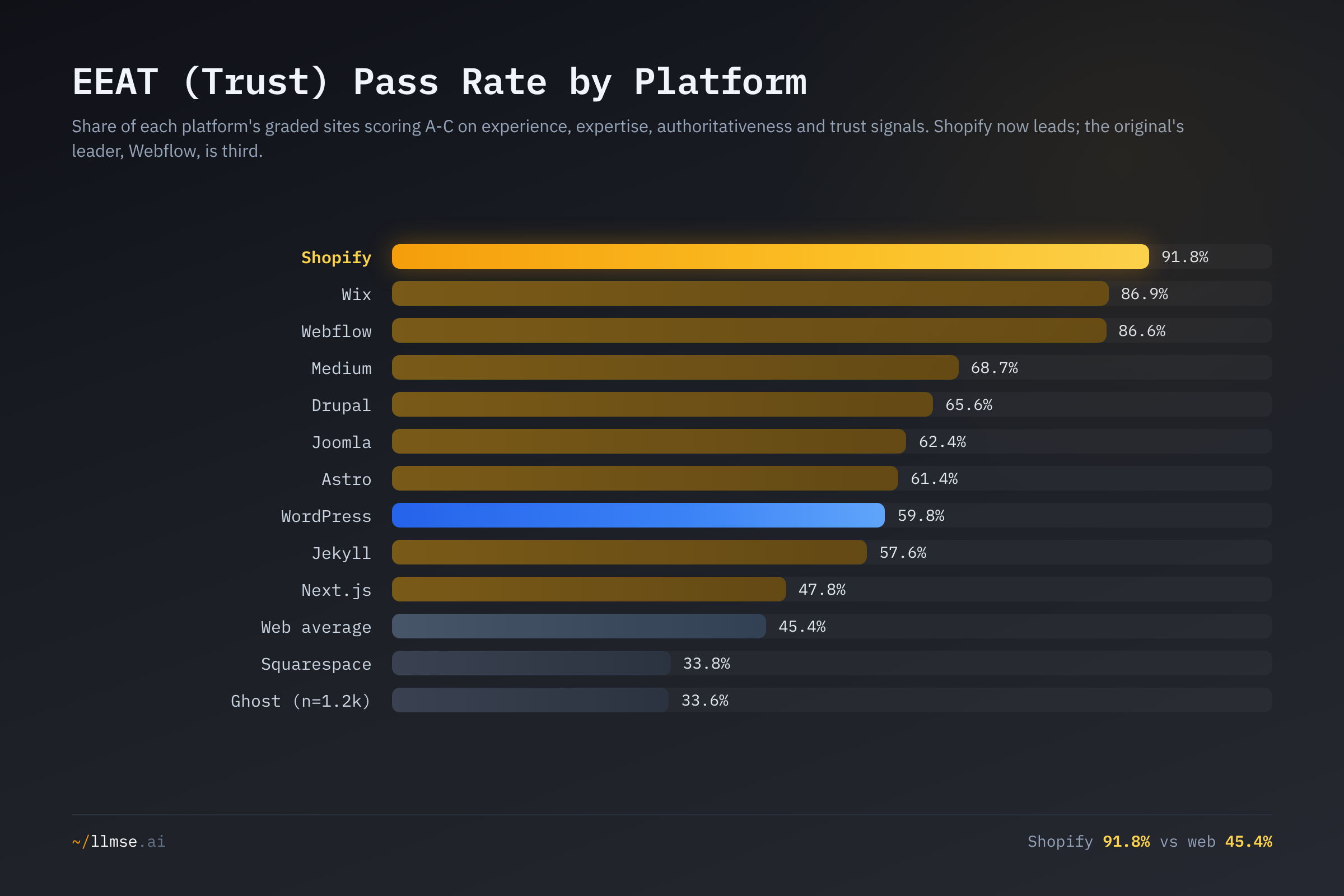
The explanation is consistent across the top of the board: the platforms that lead trust are the ones whose templates manufacture trust signals by default. EEAT measures the experience, expertise, authoritativeness, and trustworthiness markers that Google's Search Quality Rater Guidelines reward — business identity, contact details, about pages, reviews, organizational schema. A Shopify store ships with structured business identity, returns and shipping policies, payment-trust badges, and review integrations; Wix and Webflow templates bundle about-page and contact scaffolding. These are signals Google's helpful-content guidance treats as baseline credibility, and the hosted platforms generate them whether or not the owner thinks about EEAT.
Squarespace is the trust laggard at 33.8% — the worst of any well-sampled platform and a reversal from the original, where the now-defunct framing put Next.js last. Squarespace's design-forward, minimal-text templates produce visually polished pages that are thin on the structured identity and editorial signals EEAT rewards. Next.js, the original's worst at 35.4%, is now mid-pack at 47.8% — above the web average — its broader sample diluting the developer-tool concentration that dragged the early figure down. WordPress sits at 59.8%, above the web baseline and above Squarespace but below the top hosted builders; we return to its position below.
Accessibility: Developer Platforms Build Navigable Pages, Builders Cut Corners
Jekyll leads WCAG accessibility at 66.1%, with Next.js (54.3%), Squarespace (53.3%), and Drupal (49.2%) following — the only well-sampled platforms above the 43.8% web average.
| Platform | Graded | A | B | C | D | F | Pass (A+B+C) |
|---|---|---|---|---|---|---|---|
| Jekyll | 17,458 | 33.9% | 13.8% | 18.3% | 15.1% | 18.8% | 66.1% |
| Next.js | 20,786 | 25.8% | 13.1% | 15.4% | 22.8% | 22.9% | 54.3% |
| Squarespace | 26,291 | 11.9% | 26.0% | 15.4% | 20.3% | 26.4% | 53.3% |
| Drupal | 34,982 | 19.1% | 18.9% | 11.2% | 16.0% | 34.8% | 49.2% |
| WordPress | 1,048,031 | 12.1% | 14.1% | 18.8% | 16.7% | 38.2% | 45.1% |
| Astro | 23,541 | 15.1% | 9.4% | 12.4% | 16.7% | 46.3% | 37.0% |
| Medium | 288,423 | 13.2% | 11.4% | 12.0% | 15.2% | 48.2% | 36.6% |
| Joomla | 28,140 | 10.3% | 8.4% | 16.7% | 20.2% | 44.4% | 35.4% |
| Webflow | 13,322 | 6.7% | 12.5% | 12.2% | 24.4% | 44.3% | 31.3% |
| Shopify | 15,250 | 6.2% | 10.8% | 9.5% | 11.8% | 61.8% | 26.4% |
| Wix | 3,005 | 8.8% | 6.3% | 10.1% | 11.0% | 63.8% | 25.2% |
Ghost posts a higher rate (74.5%) but on only ~1,200 graded sites — too few to rank against the populations above.
Wix is worst at 25.2% and Shopify second-worst at 26.4%, both with roughly 62-64% of sites scoring F. This is the inverse of the trust ranking: the same hosted builders that manufacture trust signals also generate the heavy, widget-laden, JavaScript-driven DOMs that fail automated accessibility checks. The original named Squarespace the accessibility champion at 74.0% — but on 438 sites; across its full population it is a respectable 53.3%, no longer the leader. Jekyll's win is the mirror image of Wix's loss: hand-authored static HTML is semantic and lightweight, exactly what LLMSE's checks reward.
This is the one dimension where LLMSE diverges sharply from external tooling, and the gap is instructive. The 2025 Web Almanac reports the opposite ranking on Lighthouse accessibility — Wix 95 and Squarespace 94 lead, well above WordPress. The two are not contradictory: Lighthouse's automated accessibility audit checks a curated set of programmatic rules (color contrast, alt attributes, ARIA validity) that hosted builders are tuned to pass, while LLMSE's grade is a broader static composite that penalizes the structural weight and interactive complexity those same builders ship. As the W3C's WCAG standards note, automated testing of any kind covers only part of conformance — neither tool substitutes for manual evaluation, and the divergence is a reminder to test against more than one. The stakes are no longer theoretical: the EU's European Accessibility Act took effect on 28 June 2025, requiring e-commerce services sold into the EU to meet WCAG 2.1 AA, with penalties up to several million euros — and Shopify and Wix sit at the bottom of the accessibility board.
Readability: Shopify and the Publishers Lead, Drupal and Wix Don't
Shopify leads readability at 52.5% — the only platform where a majority of content reads at roughly an 8th-grade level or below — followed by the publishing-oriented platforms.
| Platform | Graded | A | B | Pass (A+B) |
|---|---|---|---|---|
| Shopify | 15,250 | 29.2% | 23.3% | 52.5% |
| Ghost* | 1,214 | 26.2% | 19.7% | 45.9% |
| Squarespace | 26,291 | 22.7% | 19.1% | 41.8% |
| Medium | 288,433 | 22.7% | 16.3% | 39.0% |
| Jekyll | 17,458 | 22.0% | 16.0% | 38.0% |
| Joomla | 28,140 | 19.3% | 17.7% | 37.0% |
| WordPress | 1,048,066 | 17.8% | 15.3% | 33.0% |
| Astro | 23,541 | 13.4% | 15.0% | 28.4% |
| Webflow | 13,322 | 10.7% | 16.7% | 27.4% |
| Next.js | 20,787 | 15.3% | 11.5% | 26.8% |
| Drupal | 34,983 | 8.7% | 10.9% | 19.6% |
| Wix | 3,006 | 8.7% | 8.8% | 17.5% |
*Small sample (~1,200 sites).
The original named Medium the readability champion at 75.4% — but on 5,291 sites. Across its full ~288,000-site population Medium falls to 39.0%, and Shopify's commerce copy — short product descriptions, bullet specs, direct calls to action — overtakes it. Wix is worst at 17.5% and Drupal second-worst at 19.6%. Drupal's concentration in government, education, and enterprise content (dense, formal, jargon-heavy) drags it down, the same readability deficit that afflicts the most regulated corners of the web despite the U.S. Plain Writing Act of 2010. Because 54% of U.S. adults read below a 6th-grade level, a platform whose content skews complex reaches fewer of its potential readers. One caveat applies throughout: Flesch scoring is calibrated for English, so platforms with more non-English content are understated — read these as indicative, not exact.
Privacy: A New Axis — Commerce Leads, Static Sites Forget It
Privacy is one of the two dimensions added since the original. It tracks consent gating, the presence of privacy and cookie policies, and tracker discipline — and it splits the field almost perfectly along the line of who controls the server.
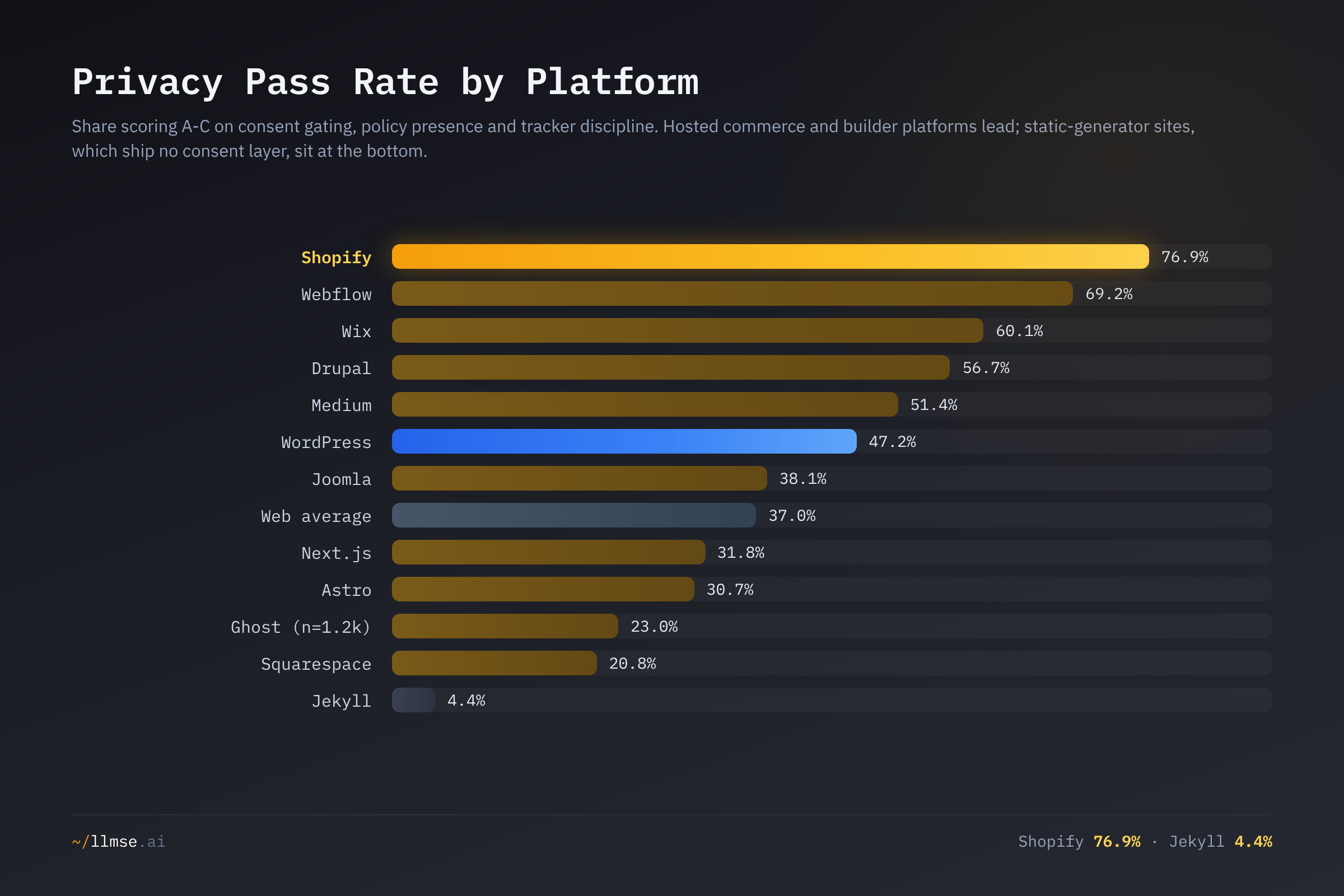
Shopify leads privacy at 76.9%, with Webflow (69.2%) and Wix (60.1%) close behind — and Jekyll dead last at 4.4%, the most extreme single result on the board. The pattern maps to infrastructure, not intent: hosted platforms run server-side, inject consent banners and policy pages, and ship managed cookie controls as a built-in part of the product, so their sites pass by default. Static-site generators produce files served from a CDN with no server-side session layer — there is no built-in mechanism to gate consent or manage trackers, so a Jekyll or Astro (30.7%) site passes only if its owner wires privacy tooling in by hand, and most do not. Where a platform owns the runtime, it adds the privacy signals; where it hands the owner a bundle of static files, it does not — a plausible structural explanation, not a proven mechanism. Squarespace's low score (20.8%) is the exception that tests the rule: a hosted platform that, unlike Shopify, does not gate consent aggressively by default.
WordPress: The Median of the Web
WordPress is the platform behind 1.06 million sites in our index — more than the other eleven combined — and its quality profile is the most boring on the board, in the most informative way.
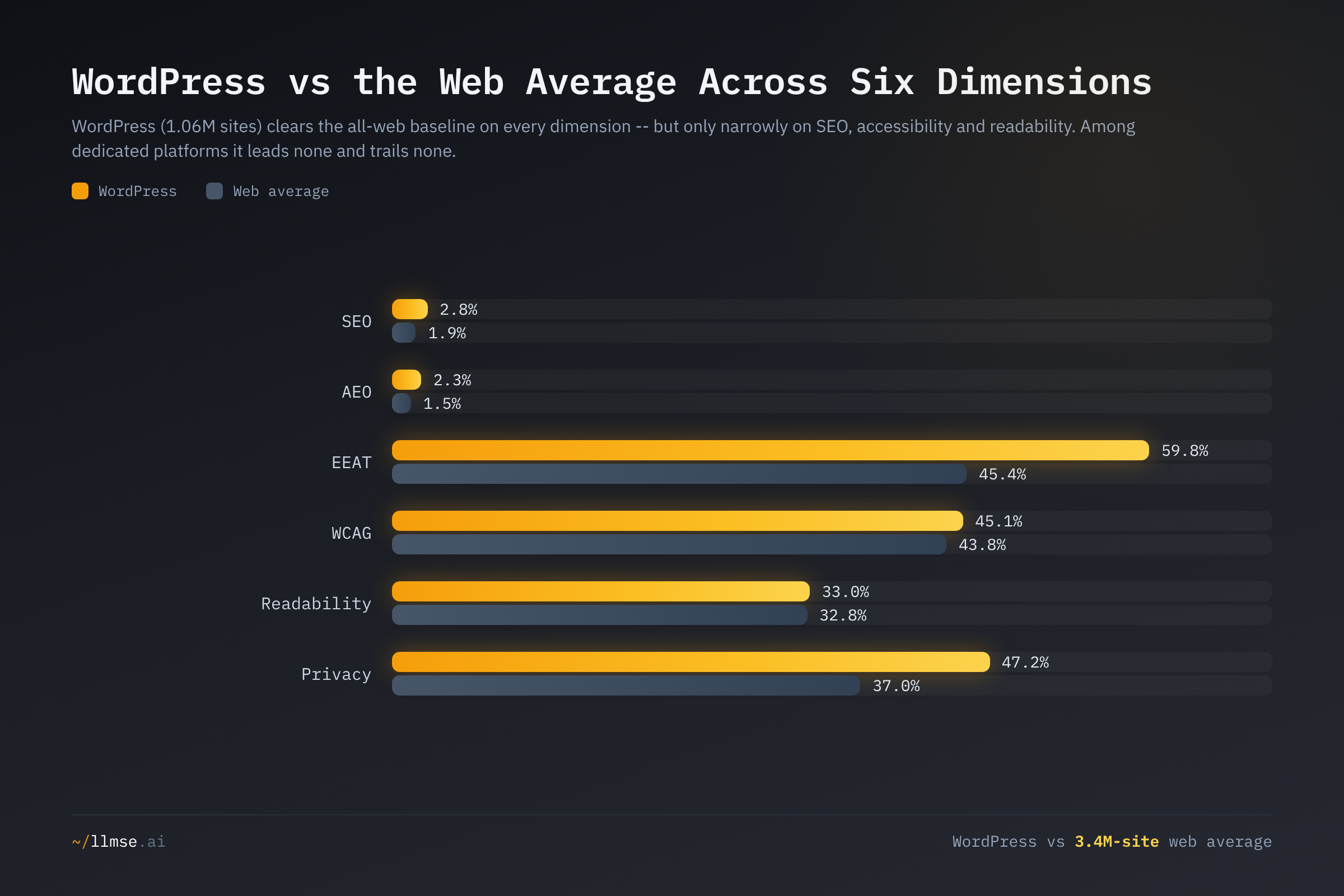
WordPress beats the all-web average on every one of the six dimensions — yet leads none of them and trails none badly. Its margins over the baseline are wide where its plugin ecosystem manufactures signals (EEAT 59.8% vs 45.4%, privacy 47.2% vs 37.0%) and razor-thin where the ecosystem cannot help (SEO 2.8% vs 1.9%, accessibility 45.1% vs 43.8%, readability 33.0% vs 32.8%). At this scale, spanning every industry, language, and skill level, WordPress has no single personality — it is, almost definitionally, the median of the web. The trade-off behind that profile — an open plugin marketplace that simultaneously generates quality signals and security exposure — is the subject of its own deep dive in The WordPress Paradox; the commerce-platform contest that pits Shopify against WooCommerce, Magento, and the rest is covered in The E-Commerce Platform Quality Index.
Why CMS Choice Predicts Quality
The leaderboards above are not random. They sort cleanly into three platform archetypes, and the archetype predicts the profile.
Hosted, opinionated platforms (Shopify, Wix, Webflow, Squarespace) manufacture content-side quality and neglect machine-readability. Because the vendor controls the template and the runtime, these platforms generate trust signals, privacy infrastructure, and readable marketing copy by default — hence their dominance on EEAT and privacy. But the same managed, widget-rich output is heavy and interactive in ways that fail automated accessibility and technical-SEO checks. They are built to convert a human visitor, not to satisfy a crawler or a screen reader.
Open, extensible CMSes (WordPress, Drupal, Joomla) produce wide variance and land mid-pack. With minimal gatekeeping over themes and plugins, outcomes depend on the operator; averaged over hundreds of thousands of sites, the variance washes out to "above the web baseline, leading nothing." Joomla's collapse on discovery is the cautionary version: weak defaults plus an aging install base equals near-total SEO failure.
Developer platforms (Astro, Jekyll, Next.js) win machine-readability and forget the human-trust and privacy layers. Clean, semantic, server-rendered HTML wins SEO and accessibility; the absence of a managed runtime and template scaffolding means no consent layer (Jekyll's 4.4% privacy) and thinner trust signals than the hosted builders.
This is exactly the conclusion the 2025 Web Almanac reaches from an entirely different dataset: "platform choice influences performance mainly through the constraints, defaults, and tooling it provides," with controlled environments delivering "steadier outcomes" while extensible systems "allow both excellent and poor implementations." Two independent measurements converging on the same mechanism is the strongest evidence here that the effect is real. The causation is plausible, not proven — platforms also attract different kinds of builders, and self-selection confounds any clean causal claim — but the direction is consistent across every dimension and both datasets: the platform sets the shape of the quality, and effort moves a site within that shape.
What's at Stake
- No platform is a quality shortcut, and the dimension you ignore is the one your platform is worst at. Shopify's owners can assume trust and readability are handled and never notice their 26.4% accessibility pass rate; a Jekyll owner has clean SEO and almost no privacy compliance. The blind spot is predictable from the platform — which means it is auditable before it becomes a problem.
- Accessibility is now a legal exposure for the platforms that fail it most. The two lowest-scoring platforms on WCAG, Wix and Shopify, are also among the most common for small-merchant e-commerce — precisely the sites the European Accessibility Act now covers, with WCAG 2.1 AA obligations and multi-million-euro penalties for non-compliance.
- Static-site privacy is a latent compliance gap. Static generators score lowest on privacy not because their owners are reckless but because the architecture ships no consent layer. A static site that adds an analytics snippet or an email form quietly inherits data-protection obligations its toolchain does not help it meet.
- AI answer engines will inherit the platform bias. Shopify already leads AEO at four times the web rate while developer and builder platforms lag. As AI answers replace blue links, content built on AEO-ready platforms will be over-surfaced and everything else will lose visibility it cannot easily buy back — a structural advantage that has nothing to do with the quality of the underlying information.
What Would Help
- Site owners: audit the dimension your platform is structurally worst at, not the one it leads. This report's central lesson is that the profile is predictable. If you run Shopify or Wix, check accessibility first; if you run a static generator, check privacy and trust; if you run WordPress, you are mid-pack everywhere and should check whichever dimension matters most to your goal. Run a full multi-dimension check at llmse.ai/classify.
- Developers on static generators and frameworks: wire in the layers your toolchain omits. Astro, Jekyll, and Next.js win SEO and accessibility for free but ship no consent gating and thin trust signals. A consent-management script, a privacy policy, organizational schema, and author attribution close the two dimensions (privacy and EEAT) where developer platforms trail — and the schema doubles as AEO fuel.
- Hosted builders and their vendors: fix the accessibility defaults you can fix centrally. Wix and Shopify sit at the bottom on WCAG with ~62% F-rates. Because these platforms control the template output, accessibility improvements made once at the platform level propagate to every site — the highest-leverage fix available to any vendor in this study, and increasingly a legal necessity under the EAA.
- Content and SEO teams: don't trust a green Lighthouse score. Lighthouse SEO scores of 92-100 reflect that platforms pass basic technical audits, not that sites are competitive — LLMSE's stricter check shows no well-sampled platform above 4.9%. Treat platform defaults as the floor and optimize past them; the SEO analyzer shows where the deductions actually are.
- Buyers choosing a platform: pick for the dimensions you cannot easily add later. Trust signals, readable copy, and SEO can be improved on any platform with effort. Enforced accessibility and built-in privacy infrastructure are harder to retrofit — so weight those defaults most heavily when the platform decision is still open.
This analysis was conducted using LLMSE, which has classified over 3.4 million websites across SEO, EEAT, AEO, WCAG accessibility, readability, GARM brand safety, and privacy dimensions. Platform pass rates reflect the populations graded on each dimension as of June 2026. To analyze your own site across every dimension in this report, visit llmse.ai/classify.