Who Writes for Humans? Shopping Writes the Web's Clearest Prose — and the Regulated Sectors the Murkiest
Update — 2026-06-29: Refreshed against LLMSE's current index of 3.4 million classified URLs (up from ~1.5M at first publication; the original measured 55,805). The hand-picked 27-site homepage ranking has been dropped for reproducible per-category aggregates, and the original's central claim that "Finance writes the clearest prose" is corrected: in aggregate, Shopping leads readability at 51.6% while Finance is only mid-pack at 39.2%. New charts add an industry leaderboard, the web-wide grade distribution, and a clear-vs-impenetrable composition view. The core thesis — most of the web reads above its audience's level — holds and sharpens at scale: only 32.8% of pages pass, and the most regulated, highest-stakes sectors (health, law, finance) are among the least readable.
Most of the web is written above its audience's reading level. Across 3,341,389 classified URLs, only 32.8% pass a basic readability check — a Flesch Reading Ease score of roughly 50 or higher, the rough equivalent of an 8th-grade reading level. The single largest group of pages, 30.7%, reads at college level. The median website is not written for the median reader.
The intuitive explanation — the one the original version of this post told — is that money and regulation buy clarity. The sectors legally compelled to communicate plainly, the story goes, should write the clearest: finance, with its consumer-protection and plain-English disclosure rules; government, bound by the U.S. Plain Writing Act of 2010; health, under pressure to make medical guidance accessible. By that logic the regulated, high-stakes verticals should top a readability ranking.
They do not. When the question is asked at scale — not across a curated sample of famous homepages, but across every site LLMSE has graded in each industry — the leaders are the consumer-content sectors that compete for clicks and conversions, and the regulated verticals sink toward the bottom.
We ranked 16 mainstream industries by the share of sites passing readability, using the readability analyzer applied uniformly across LLMSE's index. Readability is scored with the Flesch Reading Ease formula on the visible text left after navigation, scripts, and boilerplate are stripped. Every grade comes from the automated pipeline, not a hand-picked list of brands.
Shopping — not Finance — writes the clearest prose on the web, passing readability at 51.6%. The regulated trio the conventional story favors runs the other way: Finance is mid-pack at 39.2%, Health is low at 25.5%, and Law & Government is dead last at 17.3% — barely a third of Shopping's rate, despite a federal plain-language mandate aimed squarely at it. Regulation, it turns out, does not predict readability. Commercial incentive does.
The Data
Readability is graded A-F from the Flesch Reading Ease score of each page's extractable text. The web-wide distribution across 3.34M graded URLs:
| Grade | Flesch score | Reading level | Count | Share |
|---|---|---|---|---|
| A | 60-100 | 6th-8th grade | 659,054 | 19.7% |
| B | 50-59 | Some high school | 436,248 | 13.1% |
| C | 30-49 | College | 1,024,491 | 30.7% |
| D | 10-29 | Graduate | 488,470 | 14.6% |
| F | 0-9 | Postgraduate, or too little text | 733,126 | 21.9% |
Pass means A or B (Flesch ≈ 50+). On that definition 32.8% of the web passes; grade C is the single largest band, and grade F — which mixes genuinely dense prose with pages that render too little extractable text to score — is the second largest. Categories are assigned by LLM classification; the 16 sectors profiled below are LLMSE's mainstream consumer and industry categories, each with at least ~18,000 graded sites, ranging from 18,041 (Finance) to over a million (Business & Industry). Pass rates are computed over the population actually graded on each dimension, so denominators differ by sector. Russian-language sites are excluded from every aggregate.
Methodology
This post makes quantitative comparisons across sectors, so the definitions and limits matter.
- Grades and "pass." Each page is scored by the Flesch Reading Ease formula and graded A (60-100, ~6th-8th grade) through F (0-9). There is no E grade. Pass = A+B (Flesch ≈ 50+, roughly an 8th-grade level or below) — a stricter bar than the A+B+C "pass" used for SEO, EEAT, WCAG, and privacy, because readability is the one dimension where "college level" (grade C) is a failure for general-audience content.
- What the score measures. The analyzer strips navigation, headers, footers, scripts, and styles, then applies Flesch Reading Ease —
206.835 − 1.015 × (words/sentences) − 84.6 × (syllables/words)— to the remaining visible text (formula reference). The score rewards short sentences and short words. - The English-calibration caveat — read this before comparing. Flesch Reading Ease was built by Rudolf Flesch in the 1940s and refined with J. Peter Kincaid for the U.S. Navy in the 1970s, calibrated entirely on English prose. Its syllable and word-length coefficients do not transfer to other languages, so a German or Vietnamese page can score "hard" purely because the formula is the wrong instrument. We therefore rank sectors, not languages, treat cross-sector gaps as indicative rather than exact, and avoid cross-language readability comparisons entirely. Sectors with more non-English content are understated.
- Why grade F is not purely "hard writing." A score near zero means either genuinely dense prose (graduate-plus reading level) or a page with almost no extractable static text — client-side-rendered apps, image-heavy pages, or login walls. The 21.9% F band conflates the two, so it overstates how much of the web is written impenetrably and understates a separate problem: content that is invisible to anything (crawler, screen reader, AI extractor) that does not run JavaScript.
- Classification basis and cross-references. Sector membership is by LLM classification; readability is an independent automated analyzer. Per-sector rates are set intersections (Redis
ZINTERCARD) of a category index against each readability-grade index. All counts are aggregate; no individual site is identified. - Known limits. Pass rates are over graded populations, smaller than raw category size. Counts are a live snapshot and drift as classification continues. The grade is a per-page measure of reading difficulty, not of accuracy, usefulness, or design.
- Why these numbers differ from the 2026-02 original. The original measured 55,805 URLs and a 27-site homepage sample; this version measures the full 3.34M-URL index and drops the curated ranking as unreproducible. The graded population grew from ~1.5M to ~3.4M, and early grades skewed toward higher-quality, more-visible sites, so the web-wide pass rate fell from 36.0% to 32.8%. The original's headline — "Finance writes the clearest prose" — was an artifact of three hand-picked finance homepages (Chase, PayPal, Bank of America) and does not survive the aggregate.
The Scorecard
Readability pass rate for the 16 mainstream sectors, ranked. The best cell is bolded.
| Rank | Sector | Sites graded | Readability pass |
|---|---|---|---|
| 1 | Shopping | 41,105 | 51.6% |
| 2 | Beauty & Fitness | 47,126 | 47.2% |
| 3 | Food & Drink | 42,761 | 45.7% |
| 4 | Sports | 36,717 | 44.1% |
| 5 | Finance | 18,041 | 39.2% |
| 6 | Travel | 31,407 | 38.5% |
| 7 | Automotive | 66,106 | 38.2% |
| 8 | Home & Garden | 43,685 | 37.4% |
| 9 | Real Estate | 20,034 | 33.6% |
| — | Web average | 3,341,389 | 32.8% |
| 10 | News & Media | 70,497 | 31.4% |
| 11 | Entertainment | 223,388 | 31.1% |
| 12 | Business & Industry | 1,019,004 | 29.6% |
| 13 | Health | 76,402 | 25.5% |
| 14 | Education | 121,555 | 23.3% |
| 15 | Computer & Electronics | 395,649 | 21.5% |
| 16 | Law & Government | 19,234 | 17.3% |
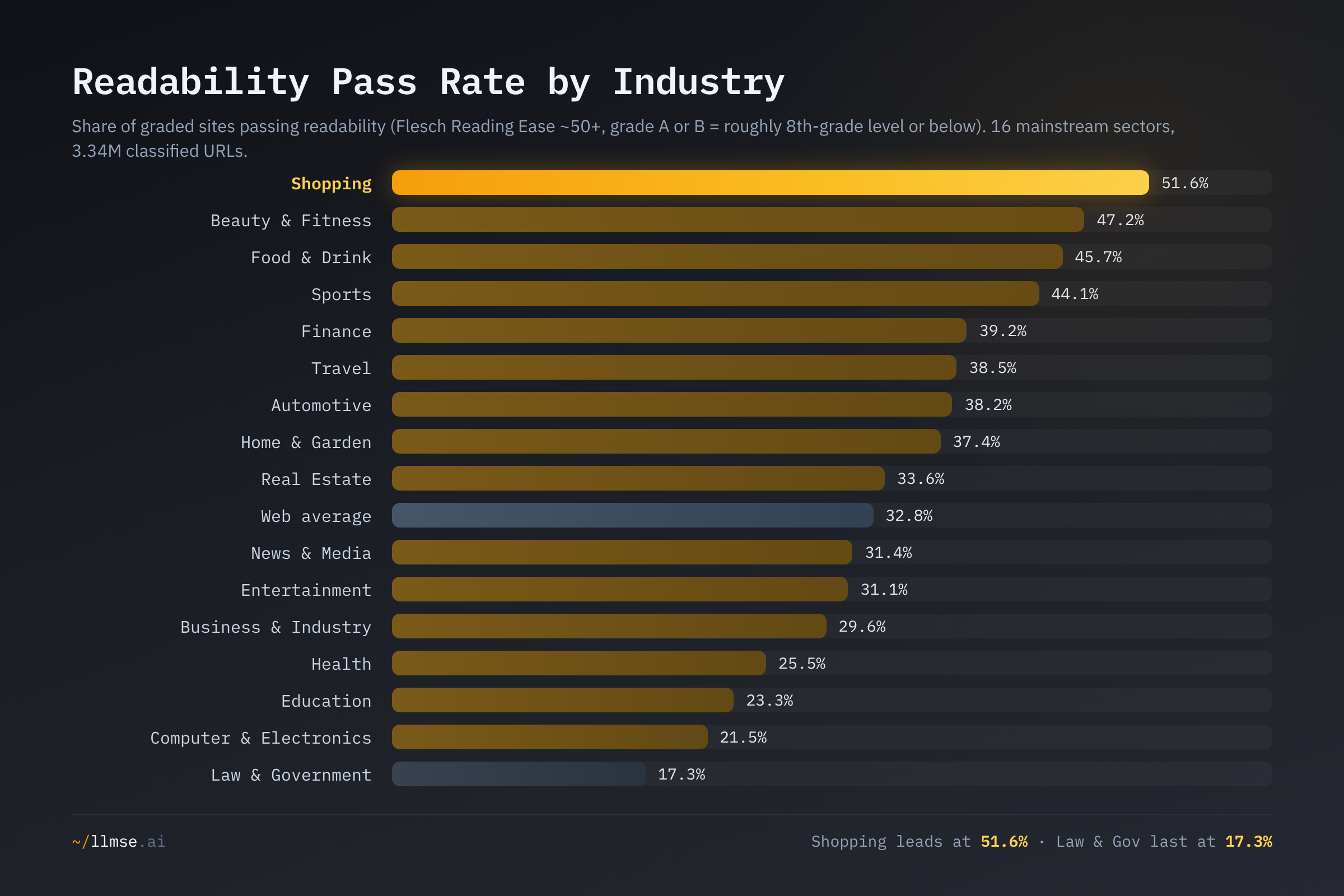
Shopping leads at 51.6% — the only sector where a majority of graded pages read at an 8th-grade level or below — and Law & Government trails dead last at 17.3%, a 34-point spread. The top of the board is consumer-facing content sold on clarity: shopping, beauty and fitness, food and drink, sports. The bottom is dense by trade: government, technical documentation (Computer & Electronics), education, and health. Finance, the original post's "clearest" winner, sits at 39.2% — above the web average, but fifth among these sixteen and nowhere near the lead. The pattern that actually holds is the opposite of the regulation story: the sectors that compete for a click write plainly; the sectors that hold a captive or obligated audience do not.
The Median Reads at College Level
The web-wide grade distribution from The Data, charted, shows where the bulk of content sits:
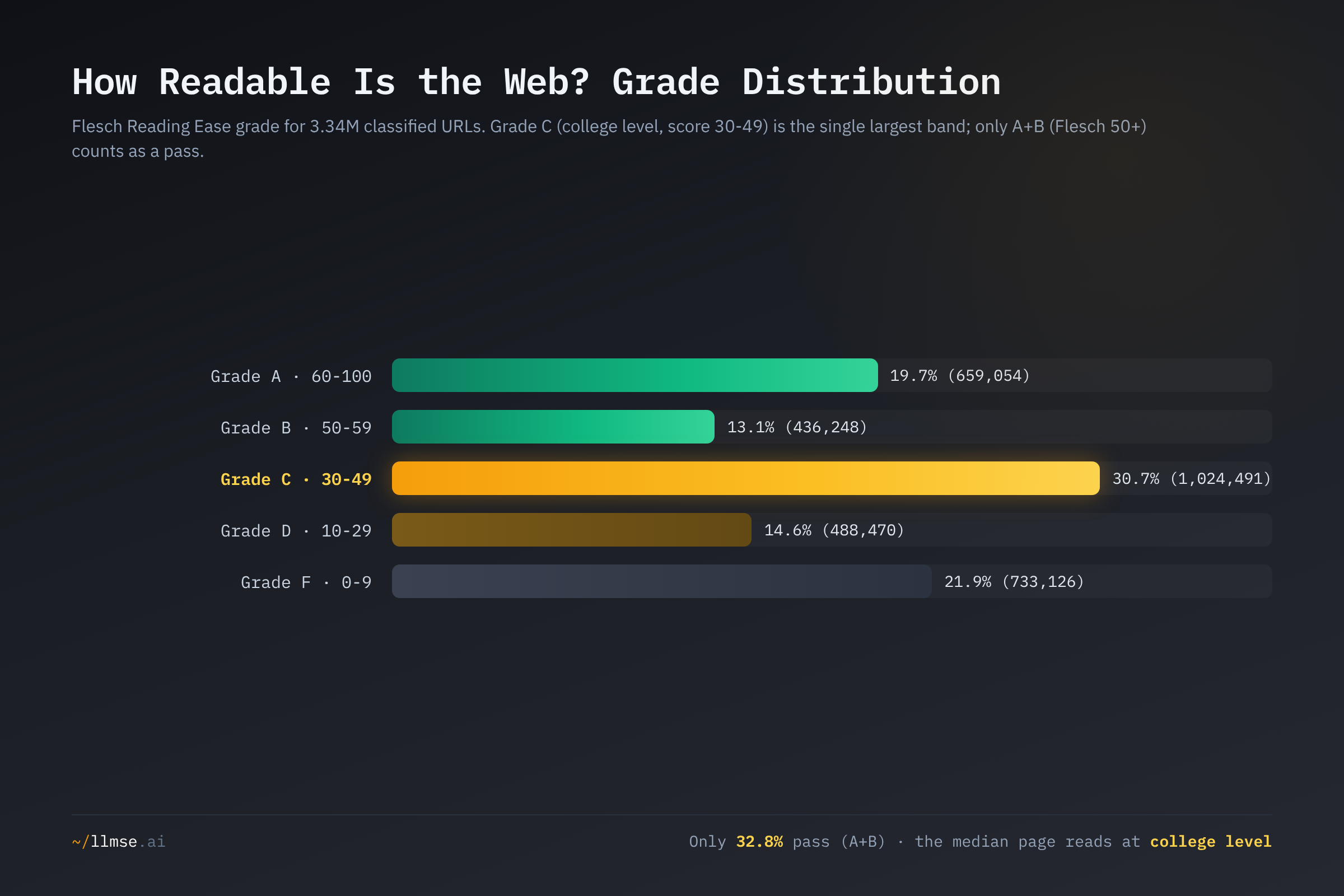
Grade C — college-level difficulty — is the single largest band at 30.7%, and only 32.8% of pages clear the A/B pass bar. Stack the failing tiers and two-thirds of the web reads above an 8th-grade level. This is the gap that matters, because reading-ease is not an academic nicety: Nielsen Norman Group's eyetracking work finds users read only about 20-28% of the words on a page and that plain language measurably helps comprehension for all literacy levels, including highly educated readers. Writing at college level for a general audience is not sophistication; it is a tax on every visitor. The 21.9% F band is the other warning: a fifth of pages either read at postgraduate density or expose too little static text to score at all — a problem for search crawlers and assistive technology as much as for human readers.
Shopping Writes Plainly, Government Doesn't
The leaderboard's extremes become sharper when split into the easiest and hardest grades. Below, the share of each sector's pages scoring grade A (Flesch 60-100, the easiest) against the share scoring grade F (0-9, the hardest):
| Sector | Grade A share | Grade F share | A-to-F ratio |
|---|---|---|---|
| Shopping | 31.9% | 13.6% | 2.3x more A |
| Finance | 20.5% | 13.9% | 1.5x more A |
| Health | 12.1% | 13.8% | roughly even |
| Law & Government | 7.9% | 20.1% | 2.5x more F |
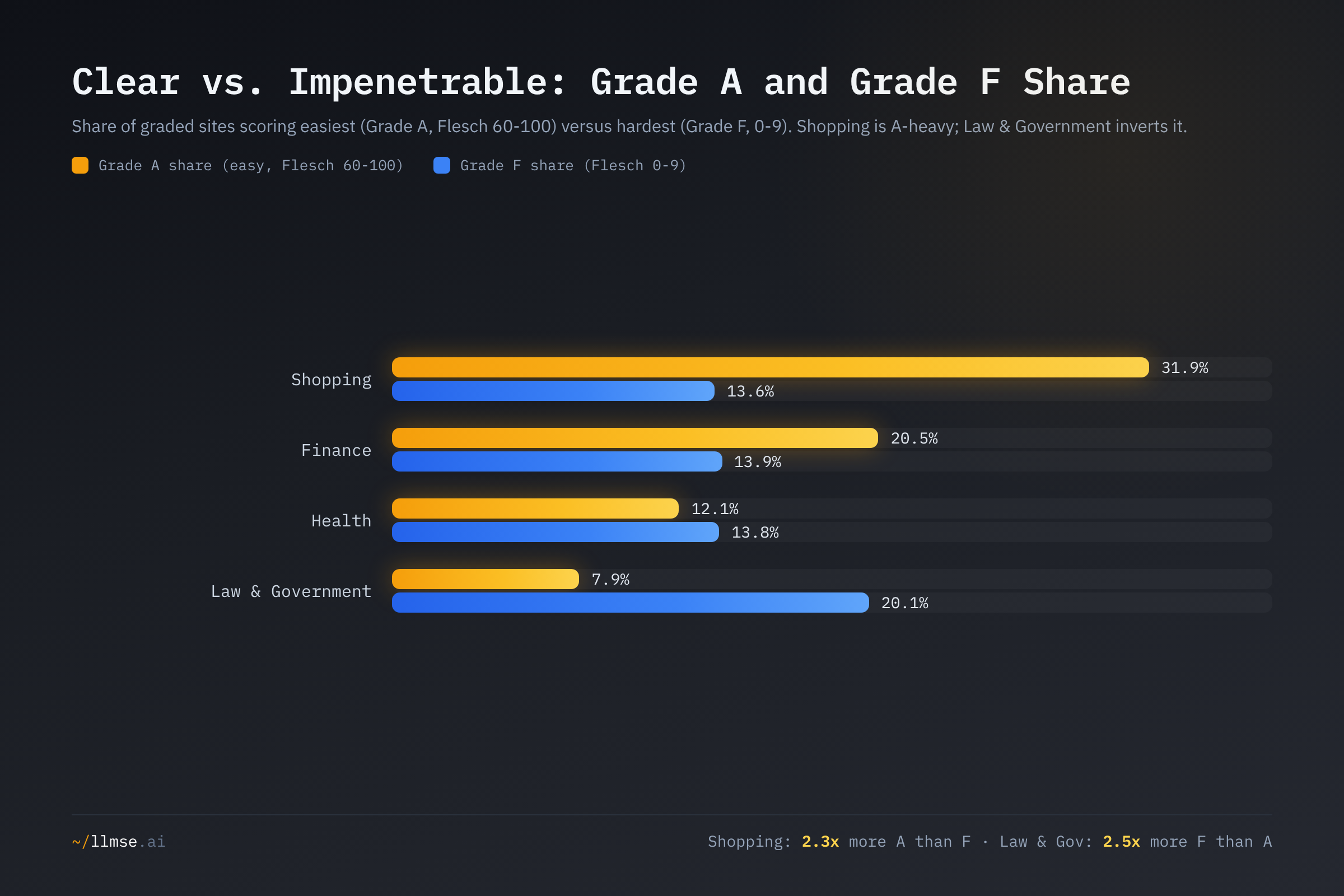
Shopping has 2.3x more grade-A pages than grade-F; Law & Government inverts it, with 2.5x more grade-F than grade-A. Product copy, pricing, and checkout flows reward clarity because dense prose loses sales — clarity is a conversion lever, and the composition shows it. Government writing runs the other way: legal, regulatory, and bureaucratic prose pushes one in five pages into the hardest grade. This is the precise failure the Plain Writing Act of 2010 was passed to fix — it requires federal agencies to write public-facing content "in a clear, concise, well-organized" way for its intended audience. Sixteen years on, Law & Government is the least readable corner of the mainstream web. The law exists; the aggregate data shows it has not moved the writing.
The Regulation Myth: Why the Clearest Sector Isn't the Most Regulated
The original post argued that regulation drives readability, with Finance as the proof. The aggregate refutes it. Pooling the three "Your Money or Your Life" verticals that face the heaviest clarity pressure — Health, Finance, and Law & Government — against the other 13 mainstream sectors:
| Group | Sites graded | Readability pass |
|---|---|---|
| Regulated / YMYL (Health + Finance + Law & Gov) | 113,678 | 26.3% |
| Other 13 mainstream sectors | 2,159,034 | 29.9% |
| Web average | 3,341,389 | 32.8% |
The most-regulated, highest-stakes sectors are the least readable — 26.3% pass, below both the other mainstream sectors (29.9%) and the web average (32.8%). This is the same readability deficit documented across all six quality dimensions in the Cross-Industry Quality Report Card: YMYL content is found and trusted but not understood. The mechanism is plausible and worth stating as a hypothesis, not a proven cause: plain-language mandates target specific documents — a fund prospectus, a benefits notice — not a sector's entire web presence, and no search or AI ranking signal rewards plain language directly, so the incentive to simplify everything is weak where the audience is captive or obligated.
Health is the starkest case. At 25.5% readability pass, it sits near the bottom even though its content is the most consequential to get right. The mismatch is well quantified in the clinical literature: 54% of U.S. adults read below a sixth-grade level and roughly 9 in 10 struggle with health literacy, the American Medical Association recommends patient materials be written at a sixth-grade level or below, yet studies of online patient-education materials repeatedly find them averaging an 11th-grade reading level. LLMSE's aggregate is the same finding at web scale: the information people most need to understand is written for an audience that mostly cannot read it comfortably. Medical terminology is genuinely unavoidable, but the 12.1%-A / 13.8%-F composition shows the balance has tipped the wrong way.
What's at Stake
- Two-thirds of the web reads above its audience. Only 32.8% of pages pass and grade C is the plurality — so for most sites, the entry-level reader is doing extra work or bouncing. With users reading a fifth to a quarter of on-page words, difficulty compounds directly into lost comprehension, engagement, and conversion.
- The highest-stakes information is the hardest to read. Health (25.5%), Law & Government (17.3%), and Finance (39.2%) are where misunderstanding does the most damage — medical decisions, legal rights, money — yet they are the least readable. Against a population where a majority of adults read below a sixth-grade level, this is a public-interest gap, not a stylistic one.
- Regulation is not closing the gap. The Plain Writing Act has bound federal agencies since 2010, and Law & Government is still the least-readable sector measured. Mandates that target individual documents leave the surrounding web presence untouched.
- Grade F is partly a discoverability blind spot. Because the 21.9% F band includes pages with too little static text to score, a low readability grade can flag content that is invisible to crawlers, screen readers, and AI answer engines alike — an SEO and accessibility liability, not only a writing one.
What Would Help
- Content teams: target grade A, not grade C. The pass bar is Flesch ≈ 50+ (≈ 8th-grade); the web's plurality sits one tier below it. Shorter sentences and common words move the score directly. Check any page's Flesch score, grade, and word count with the readability analyzer, and treat anything above a college reading level for a general audience as a defect.
- Health and medical publishers: write for a sixth-grade reader. The AMA and Joint Commission recommend a fifth-to-sixth-grade level; the literature finds patient materials averaging 11th grade. Health's 25.5% aggregate pass rate is the same problem at scale. Plain-language editing of the highest-traffic explanatory pages is the single highest-impact readability investment in any YMYL vertical.
- Government and legal publishers: enforce plain language beyond the letter of the law. Law & Government's 17.3% pass rate, sixteen years after the Plain Writing Act, shows a document-by-document mandate is not enough. Apply plain-language review to the whole public-facing site, not just the forms the statute names.
- Finance teams: extend plain English from the disclosure to the site. Finance clears the web average but ranks fifth here, not first — its clarity discipline lives in regulated documents and not the broader content around them. The plain-English playbook that produces a readable prospectus would lift the marketing, support, and explainer pages too.
- Developers: make sure the text is actually in the HTML. A share of grade-F pages score zero because their content loads only via JavaScript. Server-side rendering or pre-rendering of the primary text keeps content visible to readability graders, search crawlers, screen readers, and AI extractors — the same fix solves four problems at once.
This analysis was conducted using LLMSE, which has classified over 3.4 million websites across SEO, EEAT, AEO, WCAG accessibility, readability, GARM brand safety, and privacy dimensions. Readability figures reflect 3,341,389 URLs graded on the Flesch Reading Ease scale as of June 2026; cross-language readability comparisons are excluded because the formula is calibrated for English. To analyze your own site across every dimension in this post, visit llmse.ai/classify.