GARM Brand Safety: The Web Is 90% Safe, and the Risk Sits in Nine Categories
Update — 2026-06-29: Refreshed against LLMSE's current index of 3.4 million classified URLs (up from ~1.4M at first publication), of which 3,141,998 now carry a GARM brand-safety grade — against just 31,424 in the original. Numbers are refreshed (the brand-safe share fell from 93.8% to 90.2% as coverage broadened beyond the early, higher-quality sample) and several category mappings are corrected: Sensitive Topics is now scored as a medium-risk "Debated Sensitive Social Issue," not high-risk hate speech; News & Media and Law & Government are confirmed low-risk and grade mostly A; the analyzer now maps 5 of GARM's 11 categories, not 7. The original's curated "what advertisers see" example table was dropped in favor of reproducible aggregates. The core thesis holds and is sharper: the web is overwhelmingly brand-safe, a defined set of categories is systematically capped at medium risk, and the floor is almost entirely Adult.
Every programmatic ad impression is a brand-safety bet. The prevailing fear in the industry is that the open web is a minefield — that without aggressive blocklists, a brand's ad will surface next to something that turns into a screenshot and a crisis. That fear sells verification tools, and it shapes how billions of dollars of inventory get filtered.
The data says the fear is overstated, and misdirected. The web is not a minefield. It is overwhelmingly brand-safe, with a small, sharply defined perimeter of risk that lives in a handful of nameable content categories — and an even smaller floor that is, with near-total precision, one thing.
The shared vocabulary for this is the GARM Brand Safety Floor + Suitability Framework, published by the World Federation of Advertisers in 2020. It separates two ideas advertisers routinely conflate: brand safety (a "floor" of content no ad should ever fund) and brand suitability (graduated risk — high, medium, low — that a given brand may or may not accept). The framework defines 11 content categories and four risk tiers (Floor, High, Medium, Low), and it was carried into the IAB Tech Lab Content Taxonomy 2.2, which states plainly that "the four levels of risk are 'Floor,' 'High Risk,' 'Medium Risk,' and 'Low Risk.'"
We applied that framework as one of LLMSE's automated dimensions, scoring every classified URL by mapping its content category and sentiment onto a GARM risk tier and grade (A–F). We've now graded 3,141,998 websites, cross-referenced against the same category indices that drive the rest of our analysis.
90.2% of the graded web is brand-safe (grade A). The other 9.8% is not spread thinly across the internet — it is concentrated in nine content categories, seven of which are capped at medium risk (grade B), one (Crime) at high risk, and one (Adult) at the floor. The floor itself is 99% Adult content. Brand risk, in other words, is not a diffuse hazard. It is a list.
The Data
GARM is the one LLMSE dimension that does not parse HTML. Brand suitability is a question of what the content is, not how it is built, so the score is derived from the URL's classified category and content sentiment rather than from page markup. Of the 3.4M-URL index, 3,141,998 carry a GARM grade.
| GARM grade | Risk level | Sites | Share |
|---|---|---|---|
| A | Brand-safe (low / none) | 2,833,892 | 90.2% |
| B | Medium risk | 260,169 | 8.3% |
| C | High risk | 10,753 | 0.3% |
| D | Very high risk | 2,973 | 0.1% |
| F | Floor | 34,211 | 1.1% |
| Total graded | 3,141,998 | 100% |
Two features of this distribution drive the entire post. First, the medium-risk band (grade B) is 8.3% of the web — more than five times the floor, high, and very-high tiers combined. Brand risk on the open web is overwhelmingly a suitability question, not a safety one. Second, the genuinely dangerous tiers are vanishingly small: grades C and D together account for 0.4% of the graded web. The hard floor (F) is 1.1%.
Methodology
This post makes quantitative claims about a single LLMSE dimension, so the scoring model and its limits matter.
- The grade is deterministic from category and sentiment. A category absent from the GARM mapping scores 100 → grade A (brand-safe); most of LLMSE's 58 categories are unmapped and therefore safe. A mapped, non-floor category takes a base score by risk tier — low = 80, medium = 60, high = 30 — adjusted by a fixed sentiment delta (Good +15, Neutral 0, Bad −20) and clamped to 1–100. Floor categories (Adult) score 0 regardless of sentiment.
- Grade bands. A ≥ 80 (brand-safe), B 60–79 (medium risk), C 40–59 (high risk), D 20–39 (very high risk), F 0–19 (floor). GARM "safe" means grade A only — unlike the other LLMSE dimensions, B does not pass, because a medium-risk placement is a suitability decision, not a clean bill of health.
- What the tiers mean. This maps directly onto the framework: low tier → Good/Neutral content scores A, only negative sentiment drops it to B; medium tier → Good/Neutral scores B, negative sentiment drops it to C; high tier (Crime) → Good scores C, Neutral D, Bad F; floor (Adult) → always F.
- Mapping coverage. The analyzer maps 5 of GARM's 11 categories: Adult & Explicit Sexual Content (floor), Arms & Ammunition (medium → Military & Defense), Crime & Harmful Acts (high → Crime), Death/Injury/Military Conflict (medium → War & Conflicts, Disasters), and the broad "Debated Sensitive Social Issues" category (Gambling, Politics, Religion, Sensitive Topics at medium; News, Law & Government at low). The six unmapped GARM categories — Online Piracy, Hate Speech & Acts of Aggression, Obscenity & Profanity, Illegal Drugs/Tobacco/Alcohol, Spam or Harmful Content, and Terrorism — have no clean equivalent in the 58-category taxonomy and would require page-level text analysis to detect.
- Cross-references are set intersections (Redis
ZINTERCARD) between a grade index (e.g.garm-B) and a category or sentiment index. All counts are aggregate; no individual site is identified. Category indices are not mutually exclusive — a URL can carry more than one category tag — which produces the small cross-tier tails noted below (e.g. a handful of Sensitive Topics URLs co-tagged Crime). - Known limits. GARM grades reflect category-level mapping, not page-level adjudication: an individual page within a "safe" category can still host unsafe content the grade won't catch, and the floor depends entirely on the Adult classification being correct. The framework's authoring body, GARM, was discontinued in August 2024 after an antitrust suit from X; the WFA continues to operate, and the Brand Safety Floor + Suitability Framework remains the de facto industry standard, carried forward through the IAB Tech Lab taxonomy.
- Why these numbers differ from the original. The GARM-graded population grew from 31,424 to 3,141,998. The early sample skewed toward higher-quality, more-visible sites, so the brand-safe share fell from 93.8% to 90.2% as coverage broadened. Two mappings were also corrected since first publication: Sensitive Topics moved from high-risk "Hate Speech" to medium-risk "Debated Sensitive Social Issues," and News/Law are now confirmed at the low tier (mostly grade A) rather than the original's "low-but-flagged" framing.
The Scorecard
Plotting every grade against its share produces the shape that defines the brand-safety conversation: one tier that swallows the chart, and four slivers.
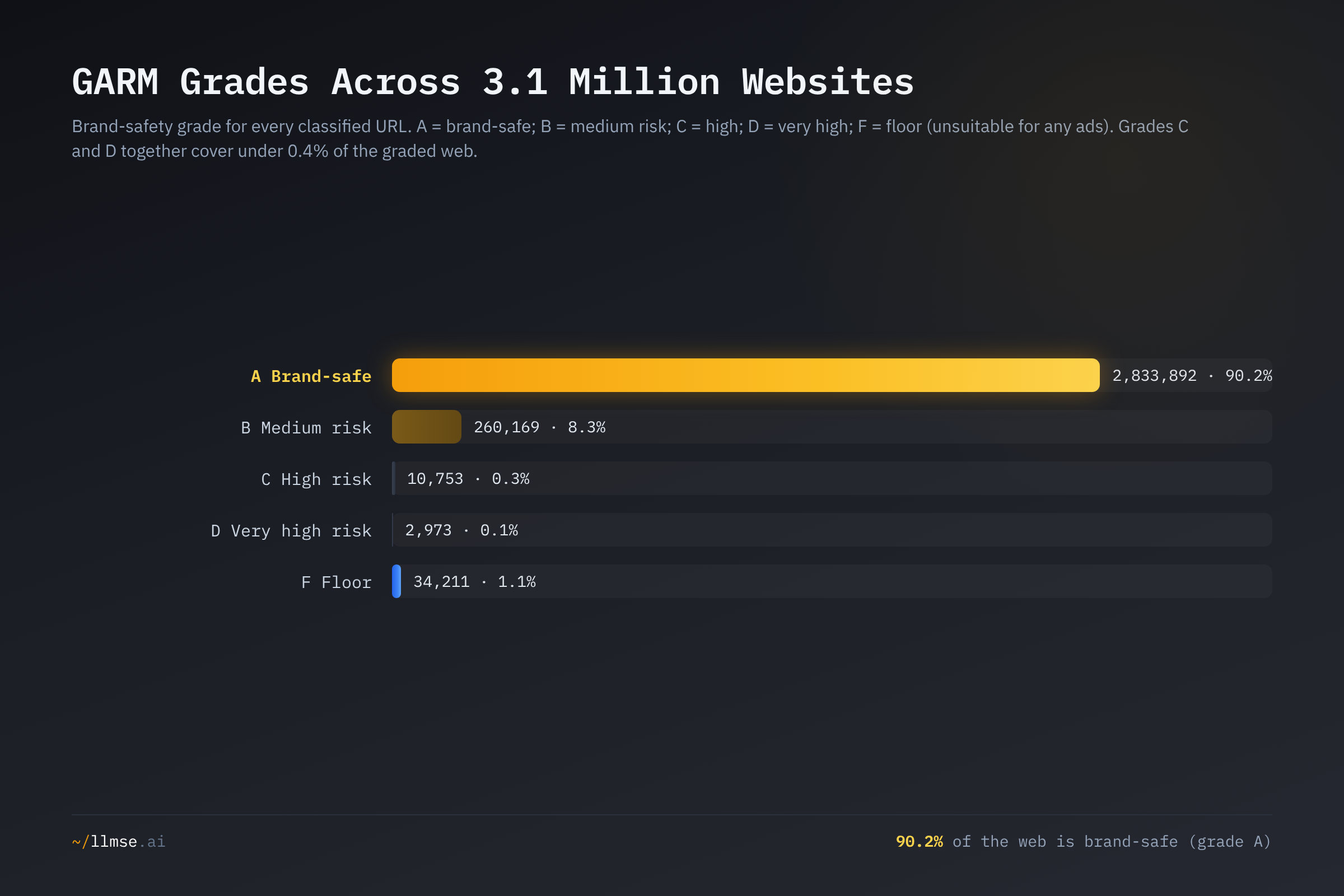
Grade A — brand-safe — is 90.2% of the graded web, and the next-largest tier, B, is medium risk at 8.3%. The two tiers most associated with the brand-safety panic, high (C) and very-high (D) risk, are together 0.4% of the web. This is the headline the framework's own logic predicts: most content is unmapped and therefore safe by default, a defined minority is suitable with controls (medium), and only a sliver is genuinely off-limits. The rest of this report is about which content sits in that minority — because the answer is unusually clean.
The Medium-Risk Band: A Defined Set of Categories, Capped at B
The 8.3% medium-risk band is not a smear of borderline pages across the web. It is seven content categories, and within each of them the cap is structural: none of these categories can earn grade A at all, because their GARM mapping sets a medium base score that even maximally positive sentiment lifts only to 75 — a B.
| Category | Sites graded | Grade B | Grade C (neg. sentiment) | % not brand-safe | GARM category |
|---|---|---|---|---|---|
| Sensitive Topics | 145,427 | 141,230 | 3,879 | 100% | Debated Sensitive Social Issues |
| Gambling | 63,384 | 62,825 | 558 | ~100% | Debated Sensitive Social Issues |
| Religion & Spirituality | 20,544 | 20,430 | 114 | 100% | Debated Sensitive Social Issues |
| Disasters | 11,552 | 11,278 | 274 | 100% | Death, Injury, or Military Conflict |
| Politics | 11,272 | 11,041 | 231 | 100% | Debated Sensitive Social Issues |
| Military & Defense | 6,519 | 6,395 | 124 | 100% | Arms & Ammunition |
| War & Conflicts | 6,036 | 5,938 | 98 | 100% | Death, Injury, or Military Conflict |
Sensitive Topics also shows 272 grade-D and 46 grade-F sites; those are URLs co-tagged with Crime or Adult, whose grade is set by the more severe category.
These seven categories supply 259,137 of the 260,169 grade-B sites — 99.6% of the entire medium-risk band. Adding Crime and Adult, the full set of non-brand-safe content collapses to nine categories that hold 99.7% of everything graded below A; every other category on the web grades essentially 100% A.
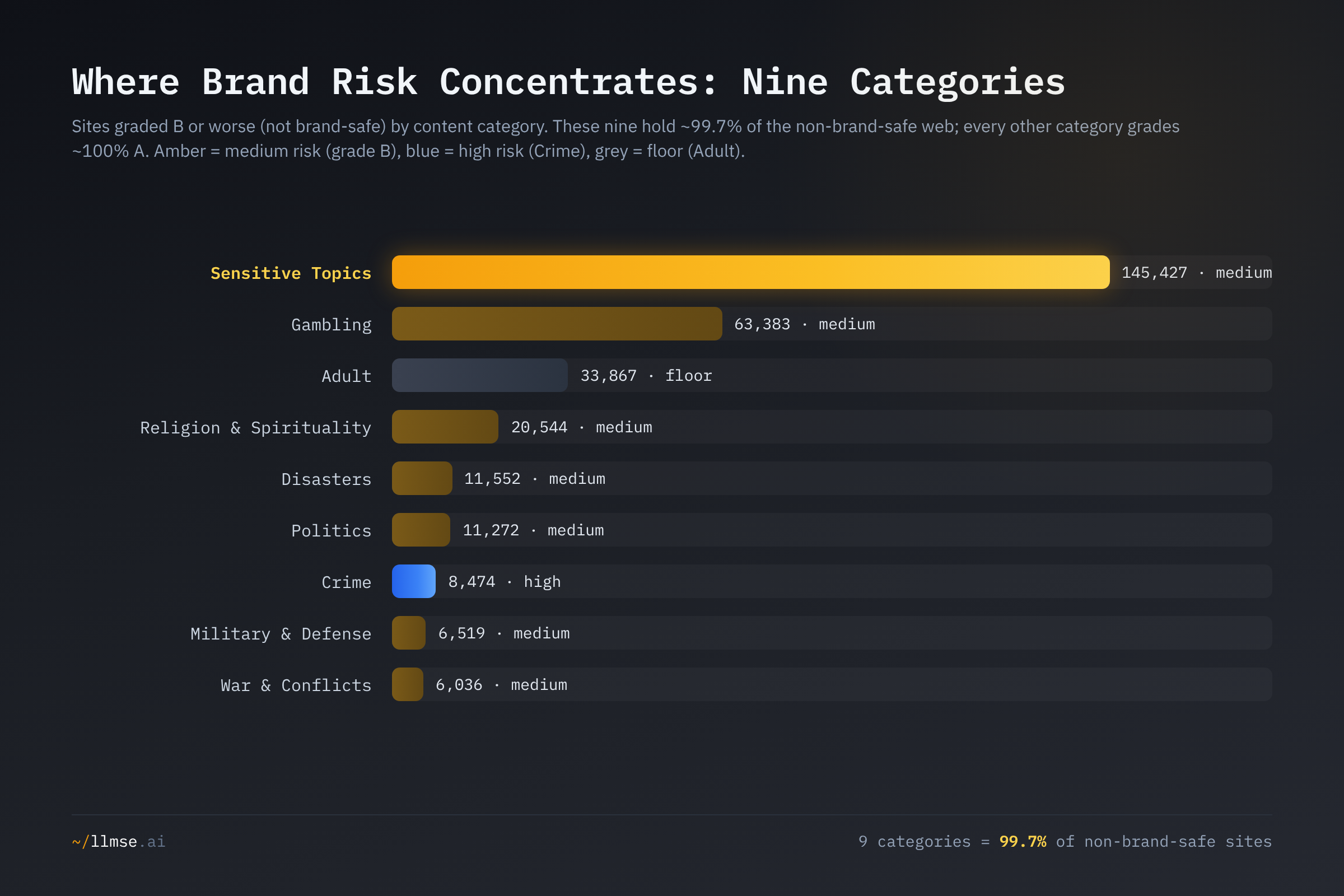
Sensitive Topics is the single largest source of non-brand-safe content at 145,427 sites — and it is the clearest correction to the original analysis. In 2026, this category was scored as high-risk "Hate Speech & Acts of Aggression." It is now mapped to the framework's broad "Debated Sensitive Social Issues" bucket at medium risk — a category the GARM framework explicitly reserves for content that is contestable rather than harmful (mental-health, social and political debate, and the like). The reclassification matters: 145,427 sites move from "many advertisers avoid" to "suitable with consideration," which is precisely the distinction the WFA built the suitability tiers to capture.
The pattern is the framework working as designed: legal, legitimate content that advertisers reasonably disagree about. Gambling is medium-risk because its legality varies by jurisdiction; religion and politics because brand tolerance for adjacency genuinely differs; arms, disasters, and military conflict because the content is sensitive without being prohibited. The IAB and WFA built the medium tier so a betting operator could monetize gambling context while a children's brand could exclude it — both expressing preferences in the same vocabulary. Gambling's near-total confinement to grade B is the same finding documented from the other direction in The House Always Optimizes: roughly 99% of gambling sites are GARM-B, which is exactly why the industry is locked out of paid inventory and pours its budget into organic search instead.
The Floor Is Almost Entirely Adult
The brand-safety floor — grade F, content the framework says is "not appropriate for any advertising support" — is the smallest and most precisely defined tier on the board.
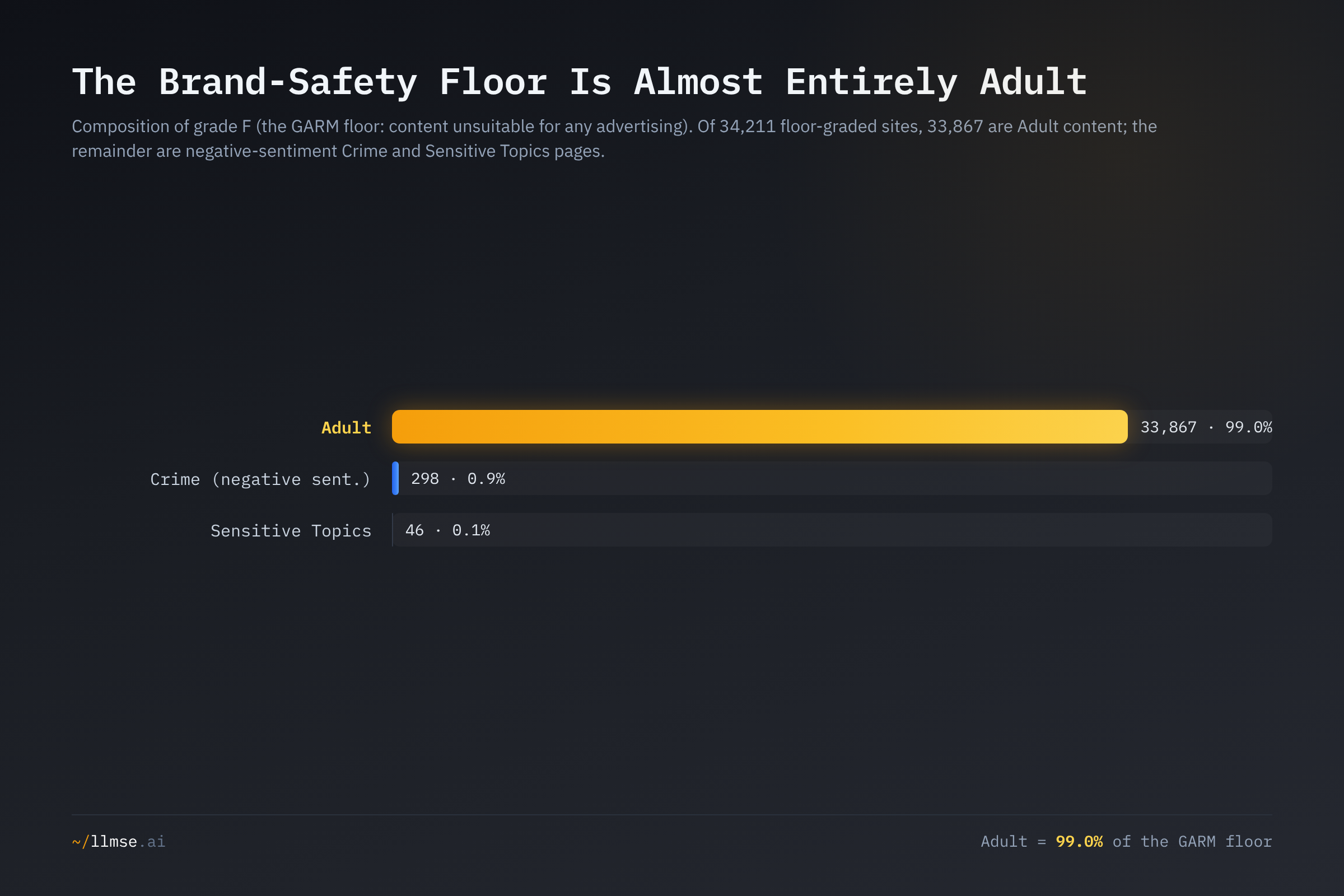
Of the 34,211 sites at the floor, 33,867 — 99.0% — are Adult content. The remaining 344 are negative-sentiment Crime sites (298) and a handful of Sensitive Topics pages (46) that sentiment dragged all the way down. Adult content scores 0 unconditionally: there is no positive framing, no editorial context, and no sentiment modifier that lifts it off the floor, consistent with the framework's treatment of explicit sexual content as an absolute exclusion rather than a suitability judgment.
The practical implication is that the part of brand safety advertisers worry about most — the catastrophic, no-defense placement — is also the part that is easiest to solve. The floor is a single, well-classified category that programmatic platforms already filter effectively. The hard problem is not the floor; it is the 8.3% medium band above it, where the right answer depends on the brand.
High Risk Is Just Crime — and Sentiment Sets the Grade
Between the medium band and the floor sits the high-risk tier, and it is one category: Crime. Crime is the only LLMSE category mapped to a high-risk GARM base score (30), and that base is low enough that sentiment alone decides whether a site lands at C, D, or F.
| Crime sentiment | Score | Grade | Sites |
|---|---|---|---|
| Good (30 + 15) | 45 | C (high) | 5,475 |
| Neutral (30 + 0) | 30 | D (very high) | 2,701 |
| Bad (30 − 20) | 10 | F (floor) | 298 |
A crime-prevention or true-crime site with positive framing scores C; the same topic reported neutrally scores D; sensationalized with negative sentiment, it hits the floor. This is the sharpest illustration of sentiment as the swing factor — a 35-point span on identical subject matter. It also explains a clean, reproducible fact about the whole web: every one of the 2,973 grade-D sites is neutral-sentiment, and the entire grade-D tier is Crime (and its co-tagged overlaps). D is not a populated middle ground; it is the narrow output of one category meeting one sentiment.
Sentiment moves the rest of the board too, within each category's cap:
| Content sentiment | Sites graded | Grade A | Brand-safe rate |
|---|---|---|---|
| Good | 2,830,015 | 2,569,217 | 90.8% |
| Neutral | 288,565 | 247,793 | 85.9% |
| Bad | 23,463 | 16,921 | 72.1% |
Negative sentiment cuts the brand-safe rate by nearly 19 points — from 90.8% on positive content to 72.1% on negative — without changing a single category assignment. For a medium-risk site, bad sentiment is the difference between B and C; for a low-risk one, between A and B. Advertisers who filter on category alone are both over-blocking (excluding positive-sentiment medium content that may be perfectly suitable) and under-protecting (treating a category as uniformly safe when negative-sentiment pages within it are not). The framework's whole premise is that tone is part of suitability; the data shows it is the part that moves most.
What Brand-Safe Means: News and Government Clear the Bar
Two mapped categories sit in the low tier and behave almost like unmapped ones. News & Media grades 98.5% A (61,003 of 61,934), and Law & Government grades 99.4% A (15,748 of 15,850).
Both map to "Debated Sensitive Social Issues" but at the low risk level (base score 80), so positive and neutral content scores A and only negative-sentiment pages slip to B — which is exactly what the thin B tails (931 News sites, 102 Law sites) represent. This is consistent with how the framework — and advertiser behavior — treats mainstream journalism and government information: flagged as a topic that can turn contentious, but broadly safe in practice. Few brands hesitate to appear next to a national newspaper's homepage or a government services portal, and the grades reflect it. The corollary, again, is sentiment: the same low-risk mapping means a news story with strongly negative sentiment is the one case where mainstream news drops out of brand-safe inventory.
What's at Stake
- Brand risk is a list, not a fog — which makes blunt blocklisting wasteful. Nine categories hold 99.7% of non-brand-safe content; everything else grades A. Advertisers running broad keyword or category blocklists exclude far more inventory than the risk justifies, starving safe publishers of revenue to avoid a hazard that is, in aggregate, 9.8% of the web and concentrated in nameable places.
- The expensive problem is suitability, not safety. The floor (1.1%, 99% Adult) is small and already well-filtered. The 8.3% medium band — gambling, religion, politics, military, disaster and conflict coverage, and the catch-all of sensitive social issues — is where the real decisions live, and there is no universal right answer: the same grade-B inventory is welcome to one brand and unacceptable to another.
- Sentiment is the under-used lever. Negative sentiment drops the brand-safe rate 19 points and is what separates C from D from the floor within Crime. Buyers who treat a category as monolithic miss that the suitability of a placement turns substantially on tone — the dimension the framework was explicitly built to capture.
- A framework now outlives its authors. GARM the organization was shut down in August 2024, yet its taxonomy is more entrenched than ever, embedded in the IAB Tech Lab standard and in tools like this one. The vocabulary survived the politics — which is a reason to keep measuring against it, not to abandon it.
What Would Help
- Advertisers and agencies: replace blanket blocklists with tier-aware suitability rules. The floor (Adult) is worth a hard exclusion; the medium band is a brand-by-brand choice. Blocking all nine risk categories by reflex forfeits suitable grade-B inventory and the safe publishers adjacent to it. Map your own tolerance against the GARM tiers instead of a keyword list.
- Ad platforms and verification vendors: expose sentiment, not just category. Because negative sentiment is what moves a placement from B to C or from C to the floor, surfacing the sentiment dimension alongside the category lets buyers exclude the non-brand-safe 28% of negative-sentiment inventory without excluding an entire topic.
- Publishers in medium-risk categories: you cannot earn grade A, so compete on sentiment and context. Sites in gambling, religion, politics, military, disasters, and sensitive-social-issue coverage are capped at B by category — but negative-sentiment pages fall to C and lose more inventory. Editorial tone and framing are the only levers that keep you at the top of your tier. Check where you land with the GARM analyzer.
- Brand-safety teams: audit category classification, because the grade inherits its errors. GARM grading is only as good as the category and sentiment beneath it. A miscategorized Adult site that reads as "Entertainment" scores A; a benign forum tagged "Crime" scores C. Periodically validate classification on the inventory that matters rather than trusting the grade blindly.
- AI answer engines and content platforms: use suitability tiers to weight, not just to block. As generative systems decide what to surface, the floor/high/medium/low structure is a ready-made signal for prominence as well as exclusion — surface brand-safe sources by default, apply context to the medium band, and exclude the floor. The same logic that protects an ad placement protects an answer.
Explore the Data
- GARM brand-safety analyzer — score any URL's category mapping, risk tier, and grade.
- Comprehensive site audit — GARM alongside SEO, AEO, EEAT, accessibility, readability, and privacy.
- Related: The House Always Optimizes on why GARM-B status drives gambling's organic-search arms race, and The Cross-Industry Quality Report Card for how these categories compare on every other dimension.
This analysis was conducted using LLMSE, which has classified over 3.4 million websites across SEO, EEAT, AEO, WCAG accessibility, readability, GARM brand safety, and privacy dimensions. GARM figures reflect 3,141,998 sites carrying a brand-safety grade in the index as of June 2026. To analyze your own site across every dimension in this post, visit llmse.ai/classify.